Daoist Immortal Han Xiangzi (1662–1722): Art, History and Details
Daoist Immortal Han Xiangzi at the Cleveland Museum of Art: 1662–1722, porcelain with famille verte overglaze enamel decoration. Explore the work's context, creator attribution and collection history.
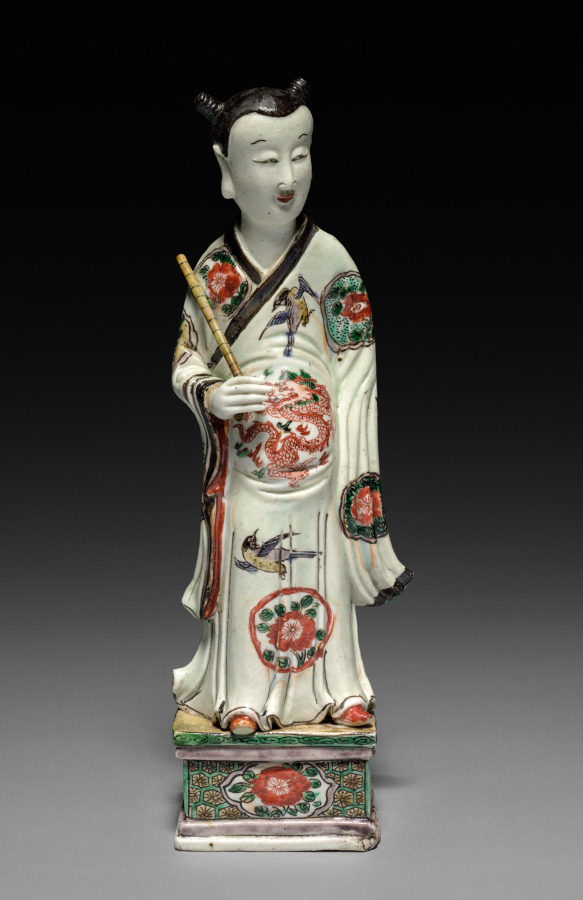
Daoist Immortal Han Xiangzi (1662–1722) is in the Cleveland Museum of Art collection.
The work and its context
The museum's open-access catalogue describes the work:
One of the Eight Immortals, Han Xiangzi was said to be the nephew of the famous Tang dynasty poet Han Yu (768–824). He is usually shown as a young boy holding a flute. Han is wearing a white robe decorated with peonies, hinting at his identity as the patron of florists and his legendary ability to make peonies bloom in winter. A four-clawed dragon, a decorative motif typically used for imperial nobility and certain high-ranking officials, decorates Han’s robe.
Object facts
- Title: Daoist Immortal Han Xiangzi
- Date: 1662–1722
- Culture: China, Jiangxi province, Jingdezhen kilns, Qing dynasty (1644-1911), Kangxi reign (1662-1722)
- Type: Ceramic
- Technique: porcelain with famille verte overglaze enamel decoration
- Dimensions: Overall: 28.3 cm (11 1/8 in.)
- Collection: China - Qing Dynasty
- Department: Chinese Art
- Accession number: 1964.194
Collection credit
Severance and Greta Millikin Collection
Further reading listed by the museum
- Catalogue of the Severance and Greta Millikin Collection. Cleveland, OH: Cleveland Museum of Art, 1990.
- Tannenbaum, Barbara. Ann Hamilton: Still and Moving: The Tactile Image. Cleveland, OH: Cleveland Museum of Art, 2025.
View the collection record
See the museum's photographs and full catalogue entry. Catalogue text is reproduced from the Cleveland Museum of Art's open-access data, with HTML formatting removed. This object and its supplied image are designated CC0.
Sources
More in Lifestyle
Keep reading