Deer (c. 1862): Art, History and Details
Deer at the Cleveland Museum of Art: c. 1862, cliché-verre. Explore the work's context, creator attribution and collection history.
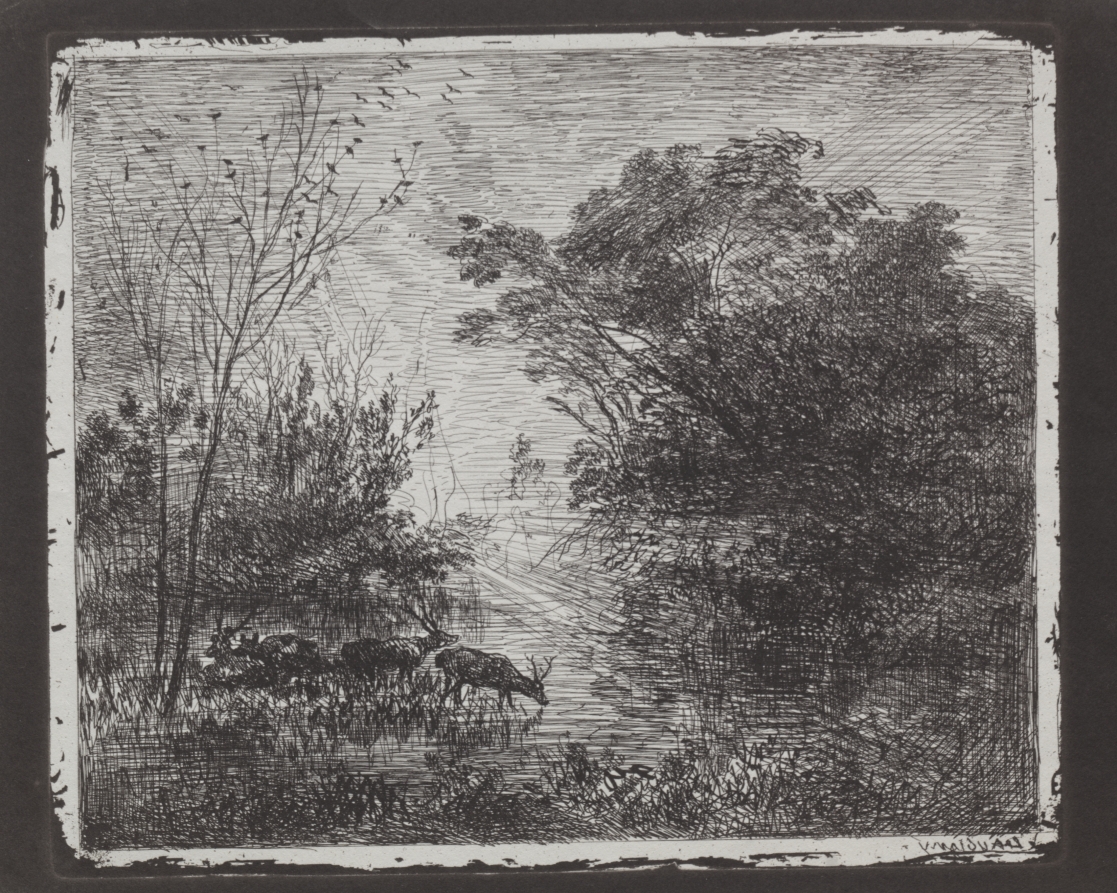
Deer (c. 1862) is in the Cleveland Museum of Art collection. The museum's creator attribution is Charles François Daubigny (French, 1817–1878).
The work and its context
The museum's open-access catalogue describes the work:
Around 1853 a few artists and photography buffs who were searching for a photographic method of producing multiple prints developed the cliché-verre. A glass plate is coated with an opaque ground through which the design is drawn with a sharp instrument. The plate is then placed on top of a sheet of light-sensitive paper and exposed to light so that the image is reproduced on the paper.
Object facts
- Title: Deer
- Date: c. 1862
- Creator attribution: Charles François Daubigny (French, 1817–1878)
- Culture: France, 19th century
- Type: Print
- Technique: cliché-verre
- Dimensions: Sheet: 17.9 x 23.9 cm (7 1/16 x 9 7/16 in.); Platemark: 16.5 x 19.8 cm (6 1/2 x 7 13/16 in.)
- Collection: PR - Cliché verre
- Department: Prints
- Accession number: 1992.340
Collection credit
John L. Severance Fund
Further reading listed by the museum
- Turner, Evan H. “The Year in Review for 1992.” The Bulletin of the Cleveland Museum of Art 80, no. 2 (February 1993): 38–79.
View the collection record
See the museum's photographs and full catalogue entry. Catalogue text is reproduced from the Cleveland Museum of Art's open-access data, with HTML formatting removed. This object and its supplied image are designated CC0.
Sources
More in Lifestyle
Keep reading