Deity-Head Vessel (900–400 BCE): Art, History and Details
Deity-Head Vessel at the Cleveland Museum of Art: 900–400 BCE, ceramic with pigment applied after firing. Explore the work's context, creator attribution and collection history.
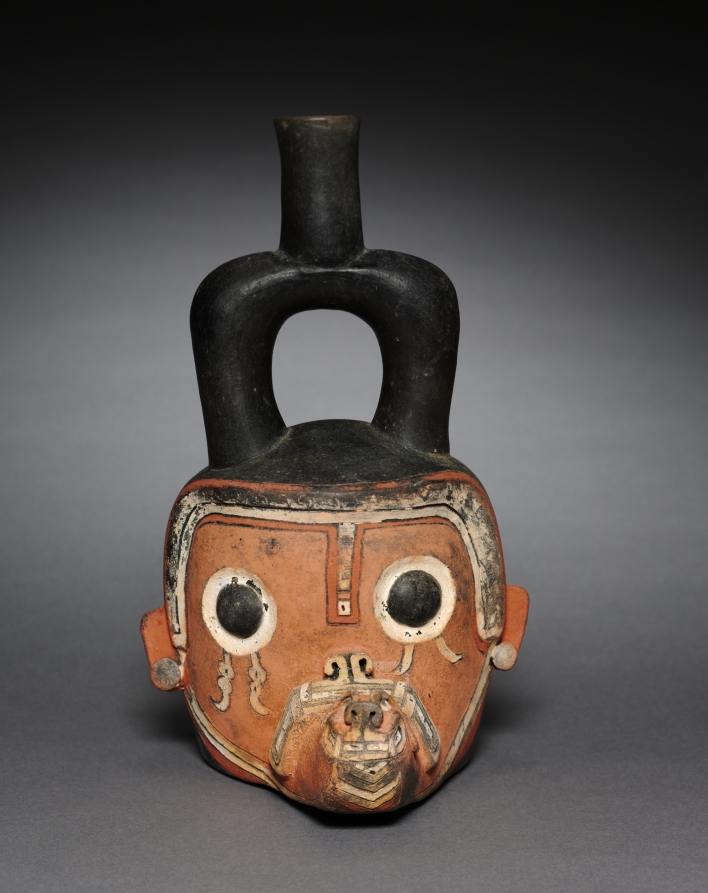
Deity-Head Vessel (900–400 BCE) is in the Cleveland Museum of Art collection.
The work and its context
The museum's open-access catalogue describes the work:
This is a stirrup-spouted vessel shaped as the effigy of a deity head with bulging, circular eyes from which hang pendants. A fanged, bandlike mouth is arranged horizontally on top of a projecting chin that is tipped with a three-dimensional, zoomorphic head. A chin strap reaches between two modeled knobs that double as ear ornaments, and the underpart of the chin is ornamented with chevrons. The face is painted red, yellow, and white over the burnished gray-black surface of the ceramic.
Object facts
- Title: Deity-Head Vessel
- Date: 900–400 BCE
- Culture: Peru, North Coast, Tembladera people, Early Horizon (900-400 BCE)
- Type: Sculpture
- Technique: ceramic with pigment applied after firing
- Dimensions: Overall: 27.6 x 14.9 x 19.2 cm (10 7/8 x 5 7/8 x 7 9/16 in.)
- Collection: AA - Andes
- Department: Art of the Americas
- Accession number: 2009.82
A detail from the museum
The Tembladera style is one of several very early styles that developed on the northern desert coast of Peru.
Collection credit
Severance and Greta Millikin Purchase Fund
View the collection record
See the museum's photographs and full catalogue entry. Catalogue text is reproduced from the Cleveland Museum of Art's open-access data, with HTML formatting removed. This object and its supplied image are designated CC0.
Sources
More in Lifestyle
Keep reading