Demon Intoning the Name of the Buddha (late 1800s–early 1900s): Art, History and Details
Demon Intoning the Name of the Buddha at the Cleveland Museum of Art: late 1800s–early 1900s, hanging scroll; ink and color on silk. Explore the work's context, creator attribution and collection history.
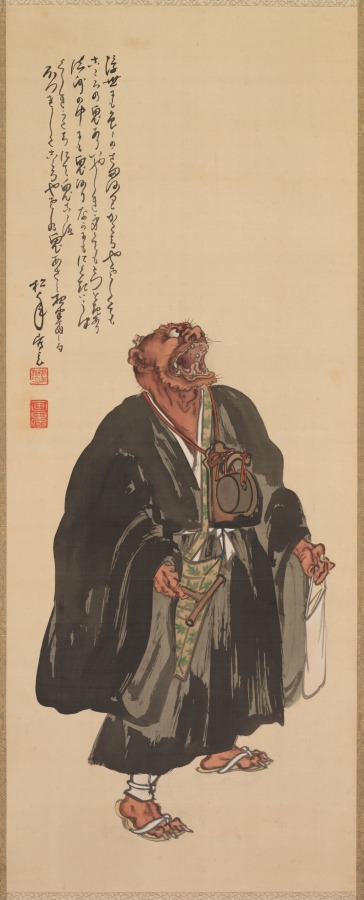
Demon Intoning the Name of the Buddha (late 1800s–early 1900s) is in the Cleveland Museum of Art collection. The museum's creator attribution is Suzuki Shōnen (Japanese, 1849–1918).
The work and its context
The museum's open-access catalogue describes the work:
Among the subjects of souvenir paintings made since the 1600s in Ōtsu, a travel hub near Kyoto in western Japan, was a demon in monk’s robes reciting the name of the Buddha Amida to the rhythm of his gong. Ōtsu paintings largely disappeared with the advent of rail travel in the late 1800s, as people no longer stopped in the area. In this work, Kyoto-based artist Suzuki Shōnen reimagined the demon for the modern era—the simple figure from the Ōtsu painting is transformed into a realistic one accompanied by a calligraphic meditation on its nature.
Object facts
- Title: Demon Intoning the Name of the Buddha
- Date: late 1800s–early 1900s
- Creator attribution: Suzuki Shōnen (Japanese, 1849–1918)
- Culture: Japan, Meiji period (1868–1912)
- Type: Painting
- Technique: hanging scroll; ink and color on silk
- Dimensions: Overall: 194.4 x 61 cm (76 9/16 x 24 in.); Painting only: 106 x 42 cm (41 3/4 x 16 9/16 in.)
- Collection: ASIAN - Hanging scroll
- Department: Japanese Art
- Accession number: 1991.77
Collection credit
Kelvin Smith Fund
View the collection record
See the museum's photographs and full catalogue entry. Catalogue text is reproduced from the Cleveland Museum of Art's open-access data, with HTML formatting removed. This object and its supplied image are designated CC0.
Sources
More in Lifestyle
Keep reading