Descent of the Nine Luminaries and the Seven Stars at Kasuga (mid- to late 1300s): Art, History and Details
Descent of the Nine Luminaries and the Seven Stars at Kasuga at the Cleveland Museum of Art: mid- to late 1300s, Hanging scroll; ink, color, gold and cut gold on silk. Explore the work's context, creator attribution and collection history.
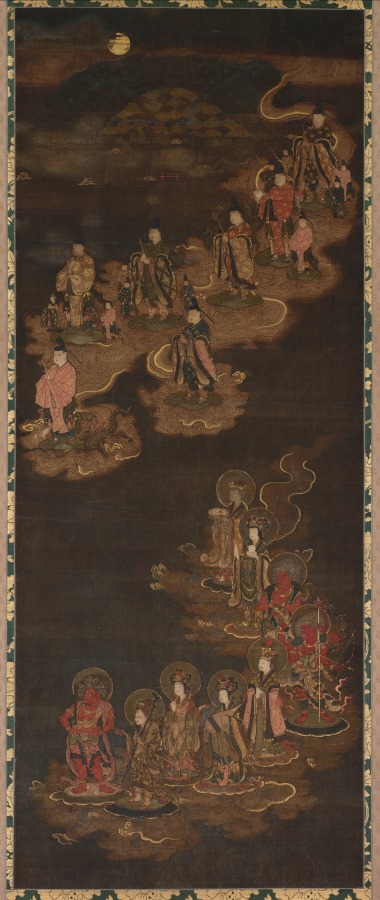
Descent of the Nine Luminaries and the Seven Stars at Kasuga (mid- to late 1300s) is in the Cleveland Museum of Art collection.
The work and its context
The museum's open-access catalogue describes the work:
This medieval religious painting shows celestial beings descending from the heavens into the Kasuga Shrine, a major religious site in Japan's ancient capital, Nara. The moon and the Kasuga mountain range appear in the uppermost portion of the painting, as does a red shrine entrance gate, or torii. In the upper part of the painting, figural representations of the stars in the constellation known as the Big Dipper in the West descend from right to left on cloud banks. In the lower part, the Nine Luminaries (Sanskrit: Navagraha) that emerged from the Vedic tradition—the sun and moon; the planets Jupiter, Mars, Saturn, Venus, and Mercury; and personifications of the fluctuating lunar nodes—descend in similar fashion. The painting uses the "deities in descent" scheme originating in China, as well as the original Buddhist form mandala (Japanese: honjibutsu mandarazu) format prevalent in medieval Japanese Shinto-Buddhist painting, to generate an image connected to the worship of celestial bodies in Esoteric Buddhism.
Object facts
- Title: Descent of the Nine Luminaries and the Seven Stars at Kasuga
- Date: mid- to late 1300s
- Culture: Japan, Nanbokuchō period (1336–92)
- Type: Painting
- Technique: Hanging scroll; ink, color, gold and cut gold on silk
- Dimensions: Mounted: 184.5 x 58.5 cm (72 5/8 x 23 1/16 in.); Painting only: 106 x 42 cm (41 3/4 x 16 9/16 in.); with knobs: 184.5 x 63.5 cm (72 5/8 x 25 in.)
- Collection: ASIAN - Hanging scroll
- Department: Japanese Art
- Accession number: 2015.63
A detail from the museum
A 19th-century copy of this painting in ink and light color exists at the Kyoto City University of Arts.
Collection credit
Lillian M. Kern Memorial Fund
Further reading listed by the museum
- Cleveland Museum of Art. Museum Masters: 2016-17 Companion Guide. [Cleveland, Ohio]: Cleveland Museum of Art, 2016.
- Vilbar, Sinéad. “Acquisitions 2015: Japanese Art.” Cleveland Art: Cleveland Museum of Art Members Magazine 56, no. 2 (March/April 2016): 34–35.
- 編集・発行奈良国立博物館., and hakkō Nara Kokuritsu Hakubutsukan henshū. 春日信仰を中心とした南都における神祇信仰の展開とその遺品に関する総合的研究. Edited by 奈良国立博物館 and Nara Kokuritsu Hakubutsukan. Nara-shi Noboriōji-chō: 奈良国立博物館, 2017.
View the collection record
See the museum's photographs and full catalogue entry. Catalogue text is reproduced from the Cleveland Museum of Art's open-access data, with HTML formatting removed. This object and its supplied image are designated CC0.
Sources
More in Lifestyle
Keep reading


