Dish with Maple Leaves in Waves (late 1600s–early 1700s): Art, History and Details
Dish with Maple Leaves in Waves at the Cleveland Museum of Art: late 1600s–early 1700s, Porcelain with underglaze blue and overglaze color enamel (Hizen ware, Nabeshima type). Explore the work's context, creator attribution and collection h
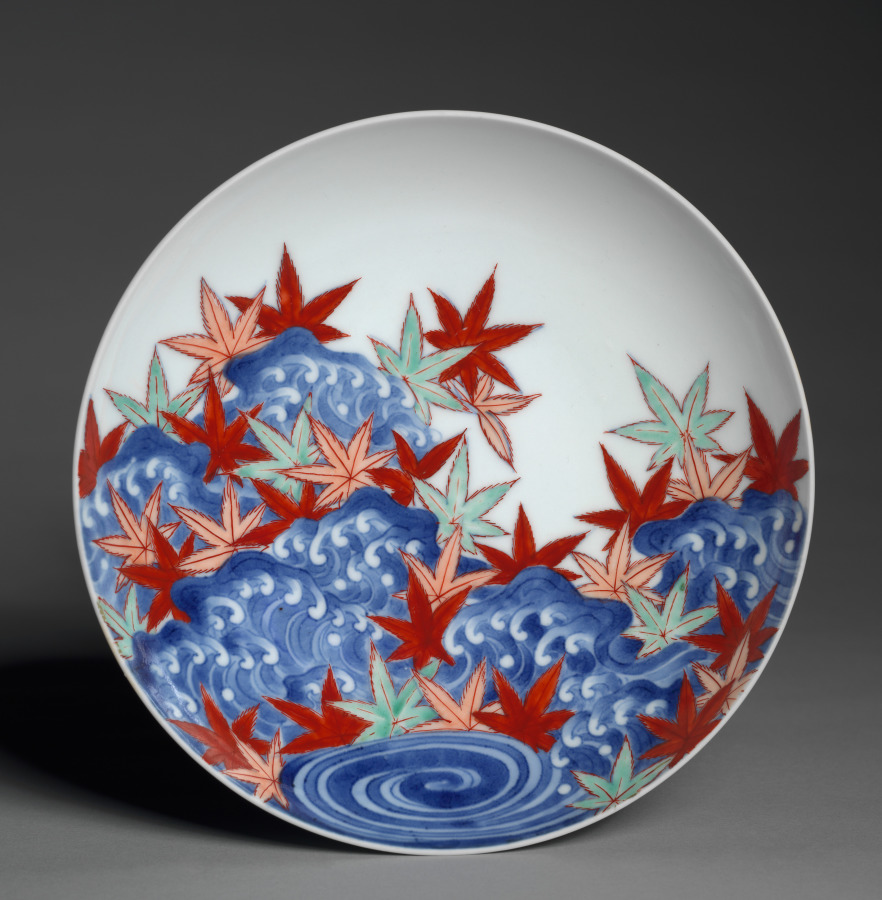
Dish with Maple Leaves in Waves (late 1600s–early 1700s) is in the Cleveland Museum of Art collection.
The work and its context
The museum's open-access catalogue describes the work:
The dish is an example of the finest type of Japanese porcelain, Nabeshima-type Hizen ware. It is decorated with maple leaves in iron-red and green and yellow enamels floating on the rough waters of a fast flowing stream in underglaze blue. It has been associated with the classical poetry motif of maple leaves on the Tatsuta River in Nara Prefecture.
Object facts
- Title: Dish with Maple Leaves in Waves
- Date: late 1600s–early 1700s
- Culture: Japan, Edo period (1615–1868)
- Type: Ceramic
- Technique: Porcelain with underglaze blue and overglaze color enamel (Hizen ware, Nabeshima type)
- Dimensions: Diameter: 19.7 cm (7 3/4 in.)
- Collection: Japanese Art
- Department: Japanese Art
- Accession number: 2017.62
A detail from the museum
This pottery type was named for the Nabeshima family, who established kilns to produce highly refined porcelain meant for diplomatic gifts.
Collection credit
Purchase from the J. H. Wade Fund
Further reading listed by the museum
- Von Spee, Clarissa. “Acquisition Highlights: Asian Art.” Cleveland Art: Cleveland Museum of Art Members Magazine 58, no. 2 (March/April 2018): 10–11.
- Guth, Christine, and P.Y. and Kinmay W. Tang Center for East Asian Art. Exemplary Things: Meibutsu in Premodern Japan. Princeton, N.J.: P.Y. and Kinmay W. Tang Center for East Asian Art, Department of Art and Archaeology, Princeton University, in association with Princeton University Press, 2025.
View the collection record
See the museum's photographs and full catalogue entry. Catalogue text is reproduced from the Cleveland Museum of Art's open-access data, with HTML formatting removed. This object and its supplied image are designated CC0.
Sources
More in Lifestyle
Keep reading