Dish with Tambourine Players (700–600 BCE): Art, History and Details
Dish with Tambourine Players at the Cleveland Museum of Art: 700–600 BCE, silver, partially gilt. Explore the work's context, creator attribution and collection history.
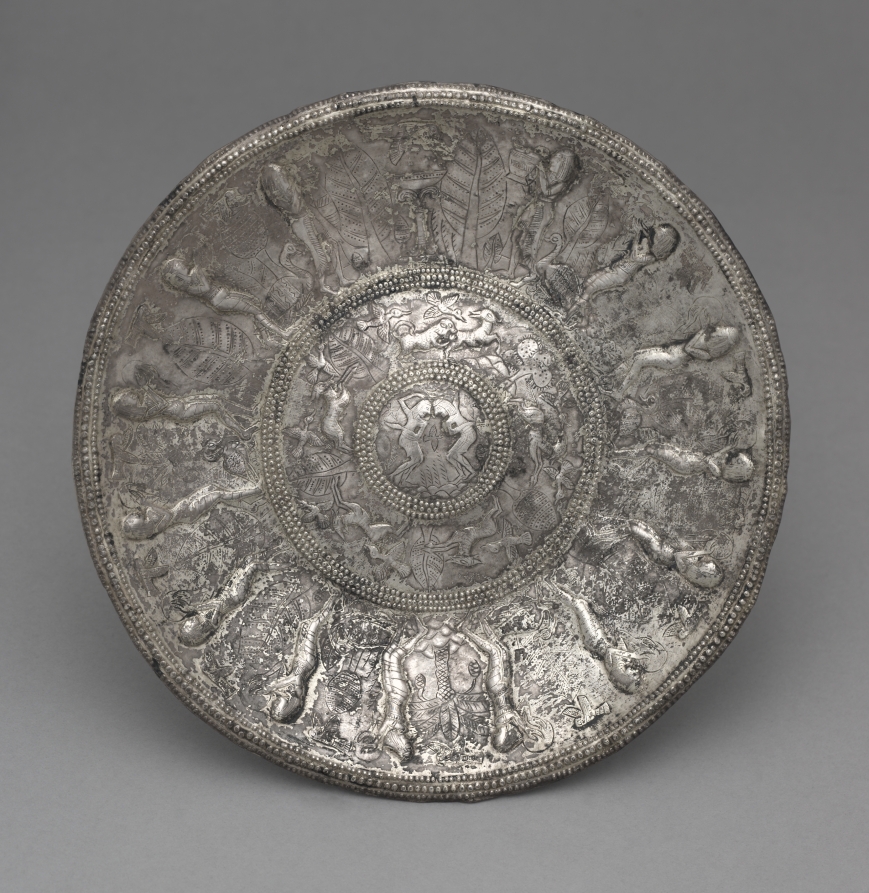
Dish with Tambourine Players (700–600 BCE) is in the Cleveland Museum of Art collection.
The work and its context
The museum's open-access catalogue describes the work:
The Phoenicians lived on the coast of what is now Israel and Lebanon from about 1200 to 700 BC. Skilled sailors, traders, and craftsmen, they are best remembered today for having developed the basis of the Western alphabet. Their travels took them to Iran, where they bought silver, and to Egypt, where they bought ivory and acquired a taste for Egyptian artistic motifs. For example, many of their works of art include sphinxes and lotuses.
Object facts
- Title: Dish with Tambourine Players
- Date: 700–600 BCE
- Culture: Phoenicia
- Type: Metalwork
- Technique: silver, partially gilt
- Dimensions: Overall: 1.3 x 19.5 x 19.5 cm (1/2 x 7 11/16 x 7 11/16 in.)
- Collection: Near Eastern Art
- Department: Egyptian and Ancient Near Eastern Art
- Accession number: 1947.491
Collection credit
Purchase from the J. H. Wade Fund
Further reading listed by the museum
- The Cleveland Museum of Art. The Cleveland Museum of Art Handbook. Cleveland, OH: The Cleveland Museum of Art, 1958.
- The Cleveland Museum of Art. Handbook of the Cleveland Museum of Art/1966. Cleveland, OH: The Cleveland Museum of Art, 1966.
- The Cleveland Museum of Art. Handbook of the Cleveland Museum of Art/1969. Cleveland, OH: The Cleveland Museum of Art, 1969.
View the collection record
See the museum's photographs and full catalogue entry. Catalogue text is reproduced from the Cleveland Museum of Art's open-access data, with HTML formatting removed. This object and its supplied image are designated CC0.
Sources
More in Lifestyle
Keep reading