Divination Implement (late 1800s–early 1900s): Art, History and Details
Divination Implement at the Cleveland Museum of Art: late 1800s–early 1900s, Wood, glass beads, and natural fiber. Explore the work's context, creator attribution and collection history.
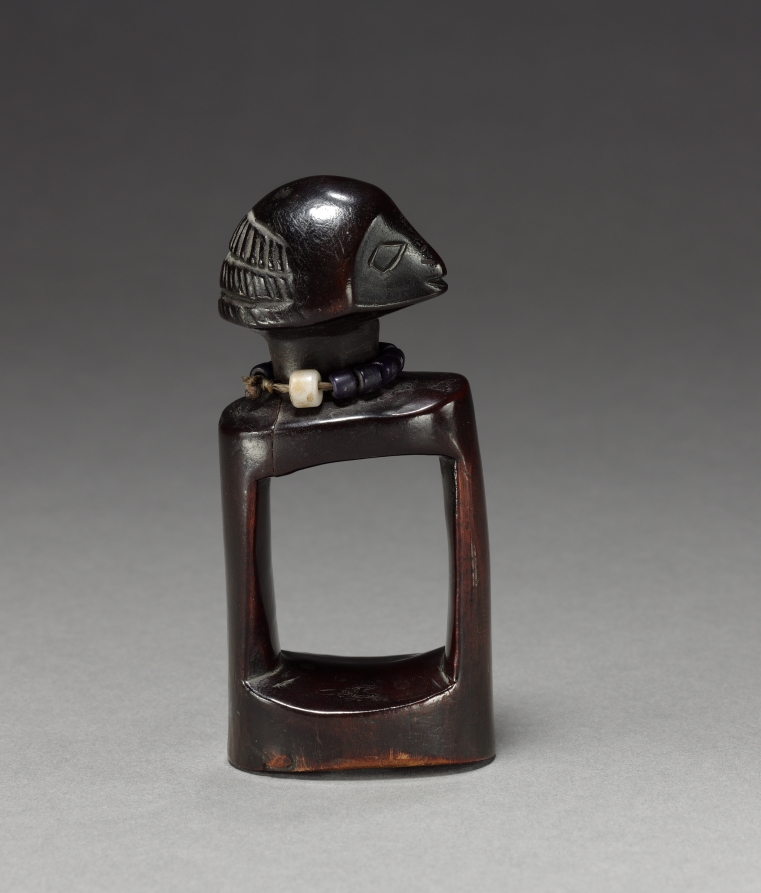
Divination Implement (late 1800s–early 1900s) is in the Cleveland Museum of Art collection.
The work and its context
The museum's open-access catalogue describes the work:
This device helped contact an ancestral spirit who clarified misfortunes. The diviner awakened the ancestor by anointing the rectangular frame of the figurine with pungent basil leaves. Sitting on a textured woven mat, the diviner held one side of the instrument while the client held the other. The diviner then posed questions to the ancestor who responded through certain movement signaling affirmation.
Object facts
- Title: Divination Implement
- Date: late 1800s–early 1900s
- Culture: Africa, Central Africa, Democratic Republic of Congo, Luba-style maker
- Type: Sculpture
- Technique: Wood, glass beads, and natural fiber
- Dimensions: Overall: 11.4 x 3.4 x 4.8 cm (4 1/2 x 1 5/16 x 1 7/8 in.)
- Collection: African Art
- Department: African Art
- Accession number: 2010.455
A detail from the museum
This divination implement is a kakishi (embodiment of an ancestor) device that connects the diviner and the client to the spirit they wish to contact.
Collection credit
René and Odette Delenne Collection, Leonard C. Hanna Jr. Fund
Further reading listed by the museum
- Petridis, Constantine, et al. Fragments of the Invisible: The René and Odette Delenne Collection of Congo Sculpture. Cleveland, OH: Cleveland Museum of Art. Milan: 5 Continents Editions, 2013, 25, 80, 84.
View the collection record
See the museum's photographs and full catalogue entry. Catalogue text is reproduced from the Cleveland Museum of Art's open-access data, with HTML formatting removed. This object and its supplied image are designated CC0.
Sources
More in Lifestyle
Keep reading