Doorknocker with Gorgon Head (mid-1500s): Art, History and Details
Doorknocker with Gorgon Head at the Cleveland Museum of Art: mid-1500s, bronze. Explore the work's context, creator attribution and collection history.
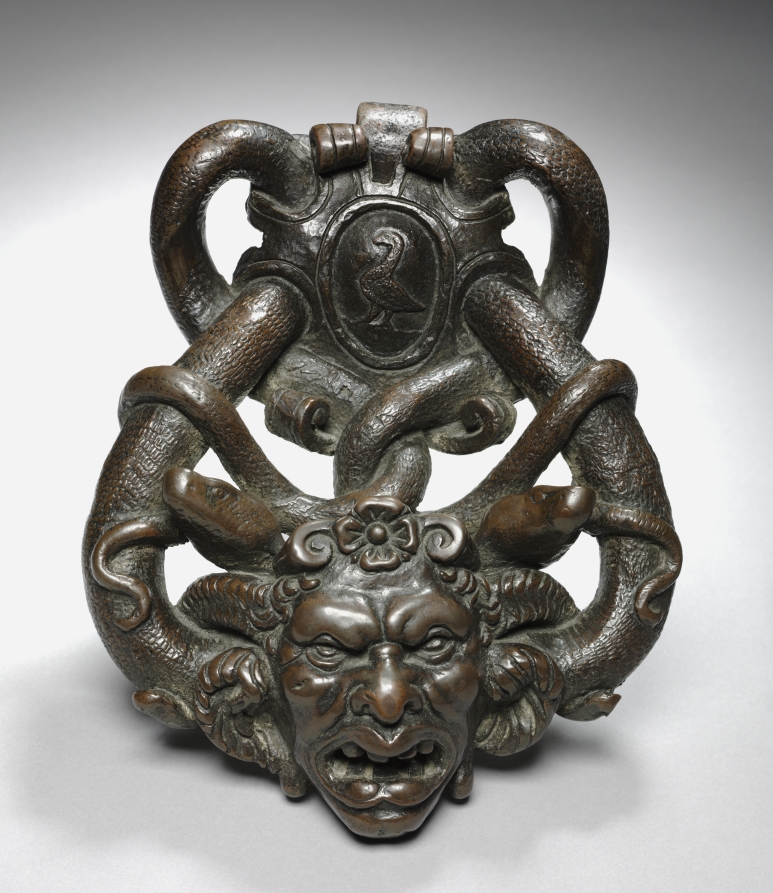
Doorknocker with Gorgon Head (mid-1500s) is in the Cleveland Museum of Art collection.
The work and its context
The museum's open-access catalogue describes the work:
Venice was a center for numerous bronze founders who made elaborate doorknockers for palace doors throughout the city. Although utilitarian, these objects were meant to impress as works of art in their own right. The presence of snakes that coil from this fearsome head suggest that this is Medusa, one of the three demon sisters in Greek mythology known as the Gorgons. According to some legends, Medusa was an attractive woman who, after having an affair with the god Poseidon in Athena's temple, was transformed by the goddess into a serpent-haired beast. Her visage was so terrifying that anyone who looked at it was turned to stone. The hero Perseus was ordered to decapitate Medusa, and Athena subsequently placed the monstrous head in the center of her shield. The use of the Gorgon's head as an ancient motif and protective symbol to avert evil developed from this fabled act. Such literary and iconographic traditions were known to Renaissance artists, and the presence of a Gorgon head on a doorknocker almost certainly evokes its guarding function for a Venetian home.
Object facts
- Title: Doorknocker with Gorgon Head
- Date: mid-1500s
- Culture: Italy, Venice
- Type: Sculpture
- Technique: bronze
- Dimensions: Overall: 25.4 x 19.7 x 6.9 cm (10 x 7 3/4 x 2 11/16 in.)
- Collection: Sculpture
- Department: European Painting and Sculpture
- Accession number: 1972.1
Collection credit
Purchase from the J. H. Wade Fund
Further reading listed by the museum
- The Cleveland Museum of Art. Handbook of the Cleveland Museum of Art/1978. Cleveland, OH: The Cleveland Museum of Art, 1978.
View the collection record
See the museum's photographs and full catalogue entry. Catalogue text is reproduced from the Cleveland Museum of Art's open-access data, with HTML formatting removed. This object and its supplied image are designated CC0.
Sources
More in Lifestyle
Keep reading