Dōtaku (100–200 CE): Art, History and Details
Dōtaku at the Cleveland Museum of Art: 100–200 CE, cast bronze. Explore the work's context, creator attribution and collection history.
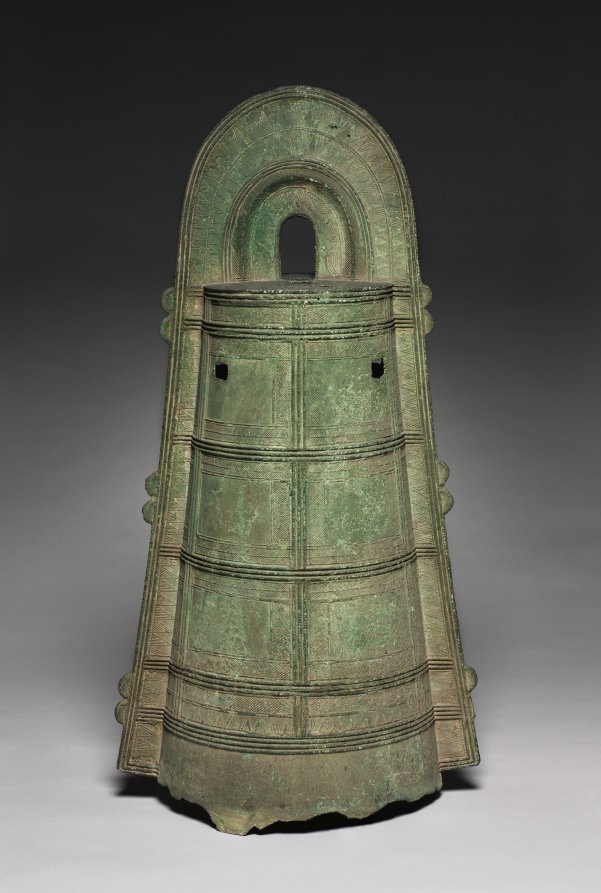
Dōtaku (100–200 CE) is in the Cleveland Museum of Art collection.
The work and its context
The museum's open-access catalogue describes the work:
The flow of new peoples from Korea to Japan during the Yayoi period brought new technologies of bronze and iron casting. Similarly, the form of the dōtaku, or bronze bell, is thought to have originated in Korea. The original Korean prototypes—stout, thickly cast bells—were transformed in Japan into sculptural forms with sophisticated surface decoration. These dōtaku are often uncovered near burial sites paired with a metal spear or sword nearby, suggesting ceremonial importance.
Object facts
- Title: Dōtaku
- Date: 100–200 CE
- Culture: Japan, Yayoi period (c. 300 BCE–300 CE)
- Type: Metalwork
- Technique: cast bronze
- Dimensions: Overall: 97.8 x 48.9 cm (38 1/2 x 19 1/4 in.)
- Collection: Japanese Art
- Department: Japanese Art
- Accession number: 1916.1102
Collection credit
Gift of Mrs. Arthur St. John Newberry
Further reading listed by the museum
- "Accessions." The Bulletin of the Cleveland Museum of Art 4, no. 2 (1917): 26-37.
- The Cleveland Museum of Art. The Cleveland Museum of Art Handbook. Cleveland, OH: The Cleveland Museum of Art, 1958.
- Feddersen, Martin. Japanese Decorative Art, A Handbook for Collectors and Connoisseurs. London: Faber and Faber, 1962.
View the collection record
See the museum's photographs and full catalogue entry. Catalogue text is reproduced from the Cleveland Museum of Art's open-access data, with HTML formatting removed. This object and its supplied image are designated CC0.
Sources
More in Lifestyle
Keep reading