Dragon and Tiger (c. 1546–56): Art, History and Details
Dragon and Tiger at the Cleveland Museum of Art: c. 1546–56, One of a pair of six-panel folding screens; ink on paper. Explore the work's context, creator attribution and collection history.
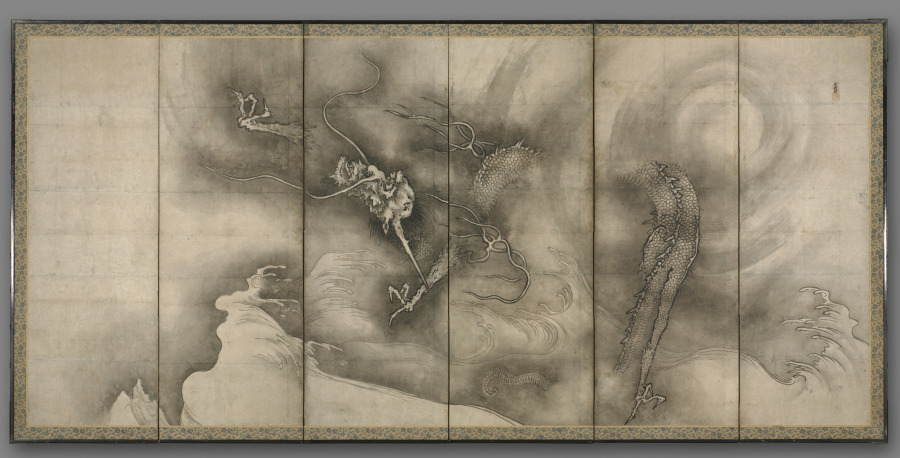
Dragon and Tiger (c. 1546–56) is in the Cleveland Museum of Art collection. The museum's creator attribution is Sesson Shūkei (Japanese, c. 1492–c. 1577).
The work and its context
The museum's open-access catalogue describes the work:
In Chinese cosmology, dragons produce rain clouds. The dragon disappearing into and reemerging from clouds in this painting seems to generate rough waves in the water below, pulling it toward the sky. The shape of the foreground wave is indirectly sampled from a painting by 13th-century Chinese painter Yujian, a handscroll once owned by the Ashikaga military rulers of Japan. Sesson must have known the famous painting though copies, and made a copy of his own. Here, the wave reinforces the powerful quality of the dragon.
Object facts
- Title: Dragon and Tiger
- Date: c. 1546–56
- Creator attribution: Sesson Shūkei (Japanese, c. 1492–c. 1577)
- Culture: Japan, Muromachi period (1392–1573) to Momoyama period (1573–1615)
- Type: Painting
- Technique: One of a pair of six-panel folding screens; ink on paper
- Dimensions: Painting: 157.3 x 339 cm (61 15/16 x 133 7/16 in.); Framed: 172.3 x 354 cm (67 13/16 x 139 3/8 in.)
- Collection: ASIAN - Folding screen
- Department: Japanese Art
- Accession number: 1959.136.1
A detail from the museum
Sesson's dragon, winding in and out of clouds, may have taken inspiration from Chinese Ming-dynasty works in the style of 13th-century Chinese painter Chen Rong.
Collection credit
Purchase from the J. H. Wade Fund
Further reading listed by the museum
- Japan. Commission imperiale a l"Exposition universelle de Paris, 1900. . Kōhon Nihon Teikoku bijutsu ryakushi. Tōkyō: Nihon Bijutsusha, 1908.
- Lee, Sherman E. “The Tiger and Dragon Screens by Sesson.” The Bulletin of the Cleveland Museum of Art 47, no. 4 (April 1960): 64–69.
- Lee, Sherman E. Japanese Decorative Style. [Cleveland]: Cleveland Museum of Art, 1961.
View the collection record
See the museum's photographs and full catalogue entry. Catalogue text is reproduced from the Cleveland Museum of Art's open-access data, with HTML formatting removed. This object and its supplied image are designated CC0.
Sources
More in Lifestyle
Keep reading