Dragon and Tiger (c. 1546–56): Art, History and Details
Dragon and Tiger at the Cleveland Museum of Art: c. 1546–56, Pair of six-panel folding screens; ink on paper. Explore the work's context, creator attribution and collection history.
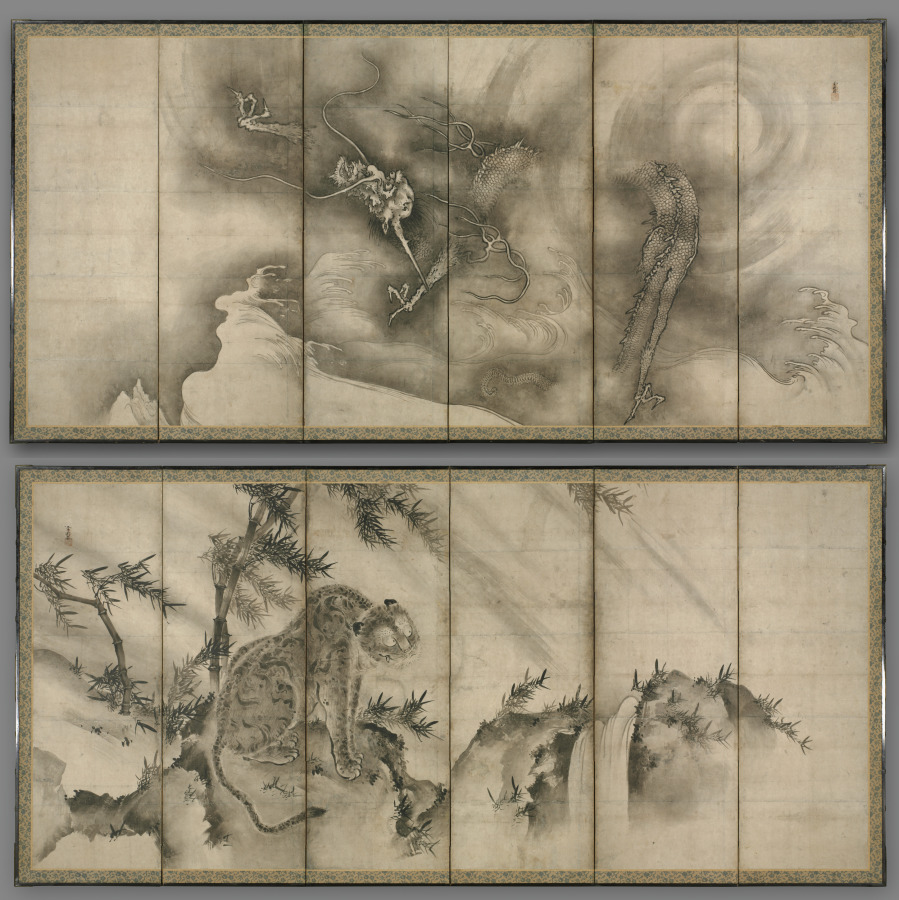
Dragon and Tiger (c. 1546–56) is in the Cleveland Museum of Art collection. The museum's creator attribution is Sesson Shūkei (Japanese, c. 1492–c. 1577).
The work and its context
The museum's open-access catalogue describes the work:
A tiger sits in a bamboo grove whipped with fierce wind, while a dragon claws through clouds above rough waves. Tiger and dragon are Chinese cosmological symbols of the balancing forces in the world, yin (the feminine aspect) and yang (the masculine aspect). The tiger's roar is also said to generate wind, and the dragon clouds. The screens may have originally been meant to express the fluctuating nature of the world as envisioned in the practice of military divination, or forecasting, based on the Yijing (Book of Changes).
Object facts
- Title: Dragon and Tiger
- Date: c. 1546–56
- Creator attribution: Sesson Shūkei (Japanese, c. 1492–c. 1577)
- Culture: Japan, Muromachi period (1392–1573) to Momoyama period (1573–1615)
- Type: Painting
- Technique: Pair of six-panel folding screens; ink on paper
- Dimensions: Each: 157.3 x 339 cm (61 15/16 x 133 7/16 in.); Framed: 172.3 x 354 cm (67 13/16 x 139 3/8 in.)
- Collection: ASIAN - Folding screen
- Department: Japanese Art
- Accession number: 1959.136
A detail from the museum
This pair of screens is considered the masterpiece of Sesson's body of work, and may have been created for the lord of Odawara in eastern Japan.
Collection credit
Purchase from the J. H. Wade Fund
Further reading listed by the museum
- Kakuzō Okakura 岡倉覺三 and Mataichi Fukuchi 福地復一 . Kōhon Nihon Teikoku bijutsu ryakushi 稿本日本帝國美術略史. Tōkyō: Nihon Bijutsusha, 1908.
- Lee, Sherman E. “The Tiger and Dragon Screens by Sesson.” The Bulletin of the Cleveland Museum of Art 47, no. 4 (April 1960): 64–69.
- Lee, Sherman E. Japanese Decorative Style. [Cleveland]: Cleveland Museum of Art, 1961.
View the collection record
See the museum's photographs and full catalogue entry. Catalogue text is reproduced from the Cleveland Museum of Art's open-access data, with HTML formatting removed. This object and its supplied image are designated CC0.
Sources
More in Lifestyle
Keep reading
![Initial M[issus est] Excised from an Antiphonary: The Annunciation (1430–1438; Cleveland 1924.431)](https://openaccess-cdn.clevelandart.org/1924.431/1924.431_web.jpg)