Dragon's Head (1100–1150): Art, History and Details
Dragon's Head at the Cleveland Museum of Art: 1100–1150, walrus ivory. Explore the work's context, creator attribution and collection history.
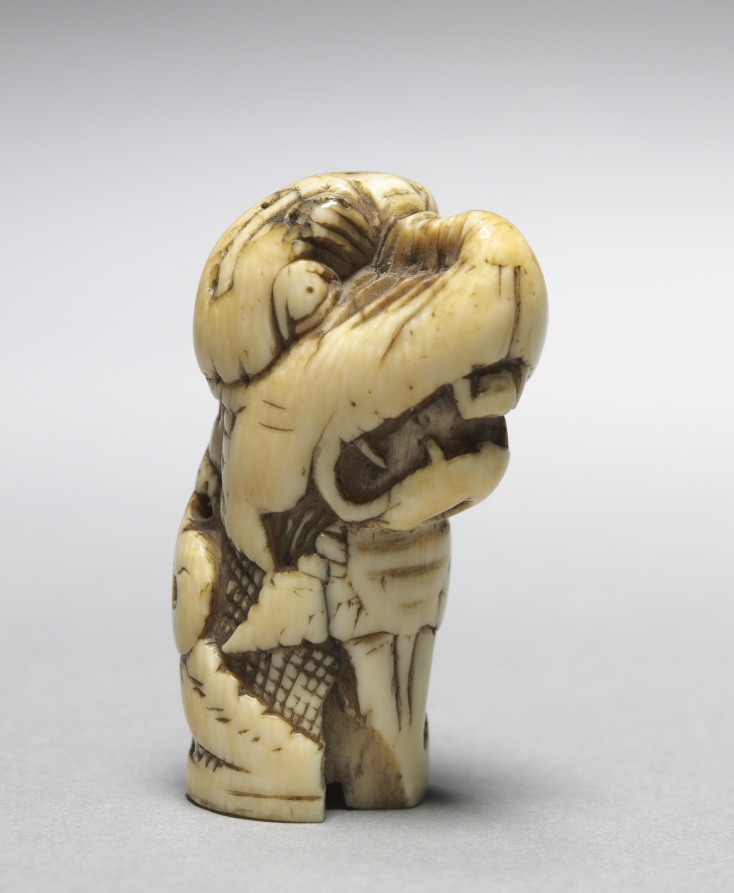
Dragon's Head (1100–1150) is in the Cleveland Museum of Art collection.
The work and its context
The museum's open-access catalogue describes the work:
This exceedingly rare medieval carving, which recalls the more monumental carvings on Viking ship prows, may have been a finial for a diagonal member of a folding chair. The character of the head, the stylized acanthus leaves, and the foliage-spouting mask on the neck are characteristic of north European and Anglo-Norman Romanesque styles.
Object facts
- Title: Dragon's Head
- Date: 1100–1150
- Culture: Anglo-Norman?, Romanesque period, 12th century
- Type: Ivory
- Technique: walrus ivory
- Dimensions: Overall: 6.4 cm (2 1/2 in.)
- Collection: MED - Romanesque
- Department: Medieval Art
- Accession number: 1975.258
Collection credit
Gift of Thomas P. Miller in memory of James J. Rorimer
Further reading listed by the museum
- Lee, Sherman E. “The Year in Review for 1975.” The Bulletin of the Cleveland Museum of Art 63, no. 2 (February 1976): 31–71.
- Wixom, William D. “Eleven Additions to the Medieval Collection.” The Bulletin of the Cleveland Museum of Art 66, no. 3 (Mar/Apr 1979): 87–151.
- Gertsman, Elina and Barbara H. Rosenwein. The Middle Ages in 50 Objects. Cambridge: Cambridge University Press, 2018.
View the collection record
See the museum's photographs and full catalogue entry. Catalogue text is reproduced from the Cleveland Museum of Art's open-access data, with HTML formatting removed. This object and its supplied image are designated CC0.
Sources
More in Lifestyle
Keep reading