Durga Destroying the Buffalo Demon (800s–900s): Art, History and Details
Durga Destroying the Buffalo Demon at the Cleveland Museum of Art: 800s–900s, schist. Explore the work's context, creator attribution and collection history.
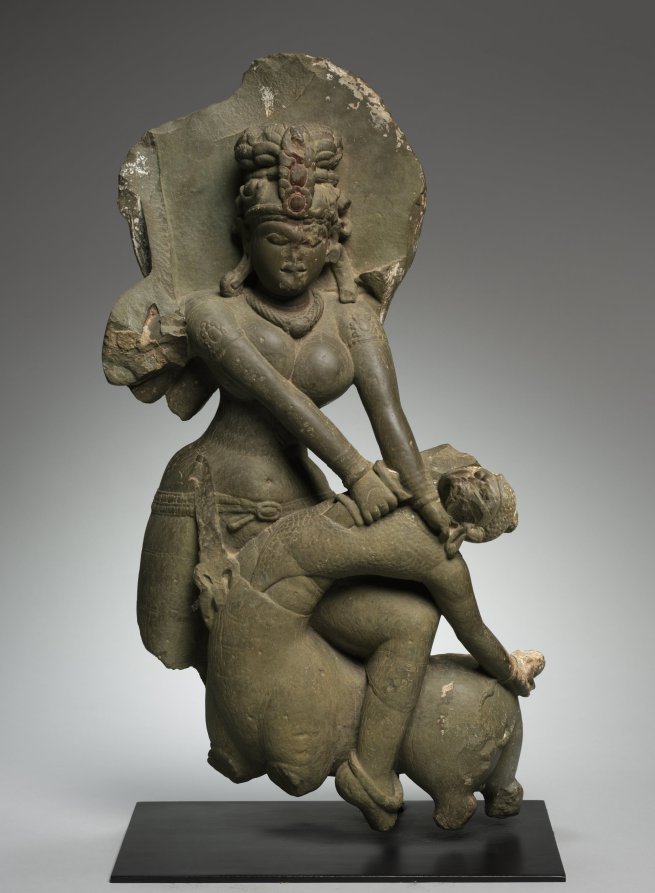
Durga Destroying the Buffalo Demon (800s–900s) is in the Cleveland Museum of Art collection.
The work and its context
The museum's open-access catalogue describes the work:
IIn Hindu traditions, the goddess Durga is sometimes understood as a form of Shiva's wife Parvati, the personification of his female energies. This female creative energy, called shakti, has a powerful side that is personified as the warrior goddess Durga, capable of destroying arrogance and other mental vices, personified as the demon. Her main feat in the mythic literature is the slaying of the Buffalo Demon, Mahishasura. He had been ravaging the universe until the warrior goddess Durga decapitated him. His more vulnerable demonic form emerges from the neck, and she, calm but powerful, slays him with her sword.
Object facts
- Title: Durga Destroying the Buffalo Demon
- Date: 800s–900s
- Culture: Northern India, Kashmir or Himachal Pradesh, 9th-10th Century
- Type: Sculpture
- Technique: schist
- Dimensions: Overall: 76.2 cm (30 in.)
- Collection: Indian Art
- Department: Indian and Southeast Asian Art
- Accession number: 1982.45
A detail from the museum
She uses Shiva's trident to pin down the demon.
Collection credit
Leonard C. Hanna Jr. Fund
Further reading listed by the museum
- Lee, Sherman E. "Year in Review for 1982." The Bulletin of the Cleveland Museum of Art 70, no. 1 (January 1983): 3-55.
View the collection record
See the museum's photographs and full catalogue entry. Catalogue text is reproduced from the Cleveland Museum of Art's open-access data, with HTML formatting removed. This object and its supplied image are designated CC0.
Sources
More in Lifestyle
Keep reading