Durga Slaying Mahisha (c. 1700–1710): Art, History and Details
Durga Slaying Mahisha at the Cleveland Museum of Art: c. 1700–1710, Gum tempera and gold on paper. Explore the work's context, creator attribution and collection history.
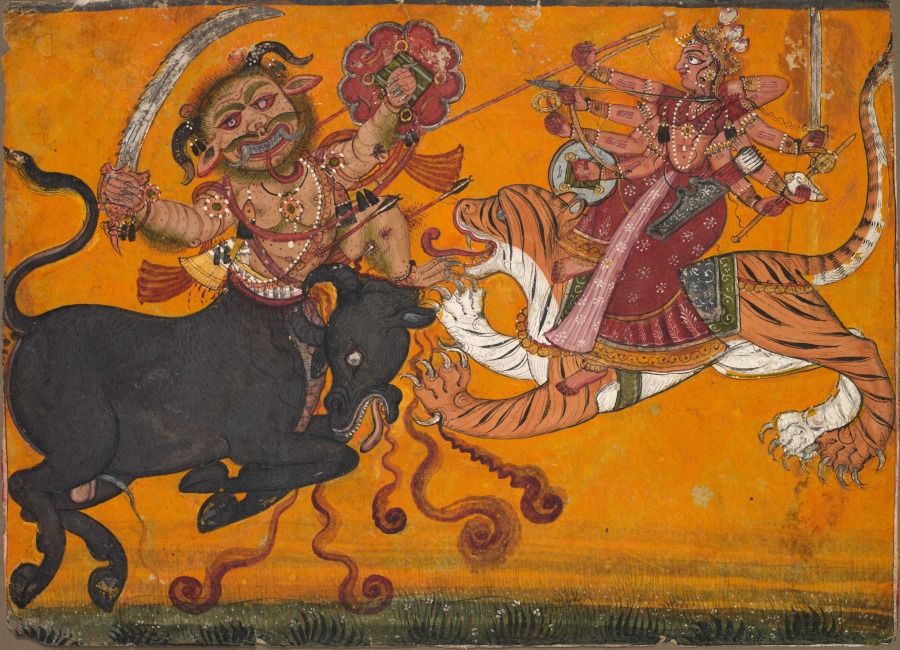
Durga Slaying Mahisha (c. 1700–1710) is in the Cleveland Museum of Art collection.
The work and its context
The museum's open-access catalogue describes the work:
Durga is the name of the goddess who personifies the sum total of the powers of all the male gods combined. When she vanquishes the fierce buffalo demon named Mahisha, she is described as having many arms, each holding a different weapon: bow and arrow, trident, discus, shield, sword, mace, and the conch shell that sounds the start of battle. The horizontal lines on her arms are sectarian markings. At the moment depicted in this painting, she has succeeded in beheading the buffalo demon and shooting arrows into his true form that climbs from its neck. Artists in the foothills of the western Himalayas, where this work was made, depicted Durga’s mount as a tiger—lions and tigers had synonymous meaning throughout India as emblems of shakti, or divine creative energy.
Object facts
- Title: Durga Slaying Mahisha
- Date: c. 1700–1710
- Culture: Northern India, Pahari kingdoms
- Type: Painting
- Technique: Gum tempera and gold on paper
- Dimensions: Overall: 15.5 x 21.2 cm (6 1/8 x 8 3/8 in.)
- Collection: Indian Art
- Department: Indian and Southeast Asian Art
- Accession number: 1960.51
Collection credit
Mr. and Mrs. William H. Marlatt Fund
Further reading listed by the museum
- Asia Society, Sherman E. Lee, and George Montgomery. Rajput Painting; with an introductory essay and catalogue notes. New York: Asia House, 1960.
- The Cleveland Museum of Art. Handbook of the Cleveland Museum of Art/1966. Cleveland, OH: The Cleveland Museum of Art, 1966.
- The Cleveland Museum of Art. Handbook of the Cleveland Museum of Art/1969. Cleveland, OH: The Cleveland Museum of Art, 1969.
View the collection record
See the museum's photographs and full catalogue entry. Catalogue text is reproduced from the Cleveland Museum of Art's open-access data, with HTML formatting removed. This object and its supplied image are designated CC0.
Sources
More in Lifestyle
Keep reading