Eight Lines of Musical Poetry of the Jajner Nauras (Rag Bhairav) of Ibrahim Adil Shah of Bijapur (verso) (late 1600s): Art, History and Details
Eight Lines of Musical Poetry of the Jajner Nauras (Rag Bhairav) of Ibrahim Adil Shah of Bijapur (verso) at the Cleveland Museum of Art: late 1600s, Gum tempera, ink, and gold on paper. Explore the work's context, creator attribution and co
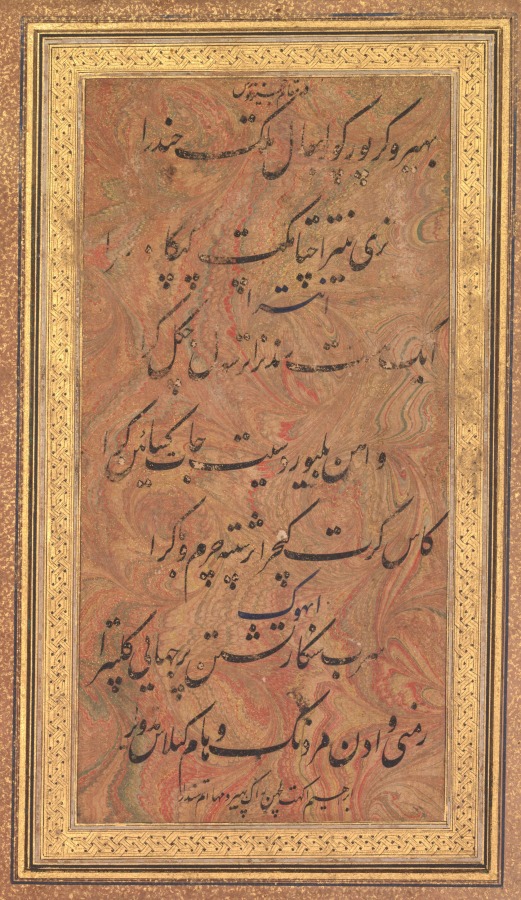
Eight Lines of Musical Poetry of the Jajner Nauras (Rag Bhairav) of Ibrahim Adil Shah of Bijapur (verso) (late 1600s) is in the Cleveland Museum of Art collection.
The work and its context
The museum's open-access catalogue describes the work:
Ibrahim Adil Shah II was a visionary ruler in the southern territories of the Deccan between 1580 and 1627 with his court based in the city of Bijapur. He maintained independence from Mughal encroachments from the north and fostered a distinctive culture infused with mystical Sufi ideals and a distinctive blending of Hindu and Islamic elements. This work of calligraphy is a verse composed by Ibrahim Adil Shah II that exemplifies his love of music and poetry. Normally a Hindu court tradition, ragamalas, or musical modes, were recast by Ibrahim Adil Shah in the local Dakhini language and incorporated into his Islamic milieu. The spectacular marbling on which the verse is written in Arabic script is a characteristic of the Deccan, where marbling was prized for its mysterious and random beauty. Mounted on an imperial Mughal album page with an image of the Hindu ruler Ram Singh on the verso, the placement of this Deccani calligraphy may have functioned as a tribute to Ram Singh’s father, who served the Mughal emperor in the Deccan from 1659 until 1666.
Object facts
- Title: Eight Lines of Musical Poetry of the Jajner Nauras (Rag Bhairav) of Ibrahim Adil Shah of Bijapur (verso)
- Date: late 1600s
- Culture: Southwestern India, Karnataka, Bijapur, 17th century
- Type: Calligraphy
- Technique: Gum tempera, ink, and gold on paper
- Dimensions: Page: 30.4 x 18.5 cm (11 15/16 x 7 5/16 in.)
- Collection: Indian Art - Mughal
- Department: Indian and Southeast Asian Art
- Accession number: 2013.330.b
Collection credit
Gift in honor of Madeline Neves Clapp; Gift of Mrs. Henry White Cannon by exchange; Bequest of Louise T. Cooper; Leonard C. Hanna Jr. Fund; From the Catherine and Ralph Benkaim Collection
Further reading listed by the museum
- Ibrahim Adil Shah. Kitab-i Nauras. Translated by Nazir Ahmad. New Delhi: Bharatiya Kala Kendra, 1956.
View the collection record
See the museum's photographs and full catalogue entry. Catalogue text is reproduced from the Cleveland Museum of Art's open-access data, with HTML formatting removed. This object and its supplied image are designated CC0.
Sources
More in Lifestyle
Keep reading