Eleven-Headed Bodhisattva of Compassion (Avalokiteshvara) (around 1000): Art, History and Details
Eleven-Headed Bodhisattva of Compassion (Avalokiteshvara) at the Cleveland Museum of Art: around 1000, gilt bronze with silver and copper inlay. Explore the work's context, creator attribution and collection history.
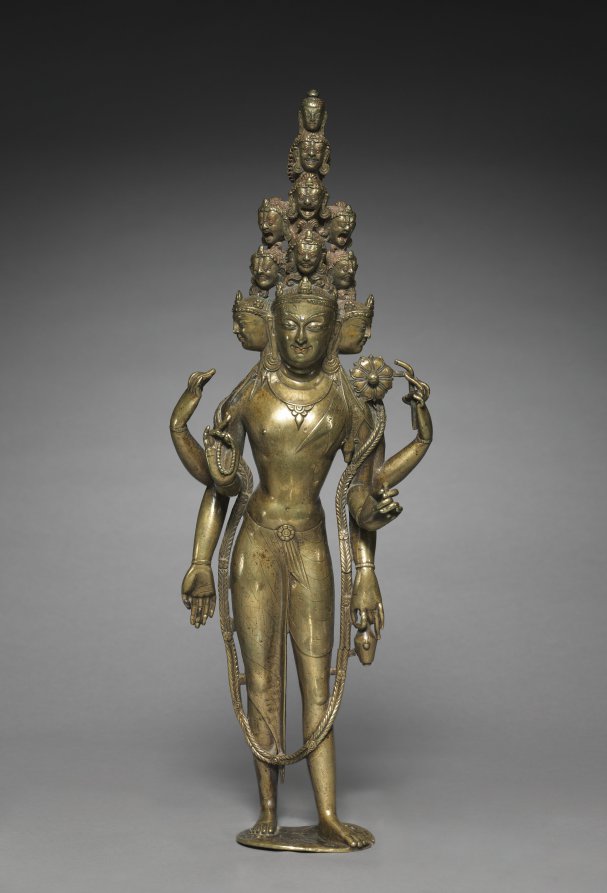
Eleven-Headed Bodhisattva of Compassion (Avalokiteshvara) (around 1000) is in the Cleveland Museum of Art collection.
The work and its context
The museum's open-access catalogue describes the work:
One of the finest surviving examples of its kind, this rare six-armed form of Avalokiteshvara has the slender athletic figure and penetrating expression associated with the art of Kashmir, the main source for western Tibetan styles. This Bodhisattva combines the qualities of a prince and an ascetic, with his crown and jewels combined with the yogi's antelope skin over his left shoulder and prayer beads in his middle right hand. Representing the range of Avalokiteshvara's forms and aspects, his eleven heads are remarkably articulated with individualized features. They follow textual descriptions that describe his three placid faces, three fierce faces, three terrifying howling faces, and one laughing face, all surmounted by a head of the Buddha Amitabha, with whom he is closely associated. Tongues and lips have been inlaid with copper to extraordinary effect, and a miniature seated figure of Amitabha Buddha has been placed in the center of every crown.
Object facts
- Title: Eleven-Headed Bodhisattva of Compassion (Avalokiteshvara)
- Date: around 1000
- Culture: Western Himalayas
- Type: Sculpture
- Technique: gilt bronze with silver and copper inlay
- Dimensions: Overall: 39.4 x 14 x 7.6 cm (15 1/2 x 5 1/2 x 3 in.)
- Collection: Tibetan Art
- Department: Indian and Southeast Asian Art
- Accession number: 1975.101
A detail from the museum
The bottle in his lower-left hand contains the nectar of immortality.
Collection credit
Andrew R. and Martha Holden Jennings Fund
Further reading listed by the museum
- Lee, Sherman E. “The Year in Review for 1975.” The Bulletin of the Cleveland Museum of Art 63, no. 2 (February 1976): 31–71.
- The Cleveland Museum of Art. Handbook of the Cleveland Museum of Art/1978. Cleveland, OH: The Cleveland Museum of Art, 1978.
- Schroeder, Ulrich von. Indo-Tibetan Bronzes. 1st ed. Hong Kong, Glattbrugg, Switzerland: Visual Dharma Publications; Sole distributor, Nanda Distribution, 1981.
View the collection record
See the museum's photographs and full catalogue entry. Catalogue text is reproduced from the Cleveland Museum of Art's open-access data, with HTML formatting removed. This object and its supplied image are designated CC0.
Sources
More in Lifestyle
Keep reading