Embroidered Front of an Altar (1600s–1700s): Art, History and Details
Embroidered Front of an Altar at the Cleveland Museum of Art: 1600s–1700s, Satin and silk: embroidery. Explore the work's context, creator attribution and collection history.
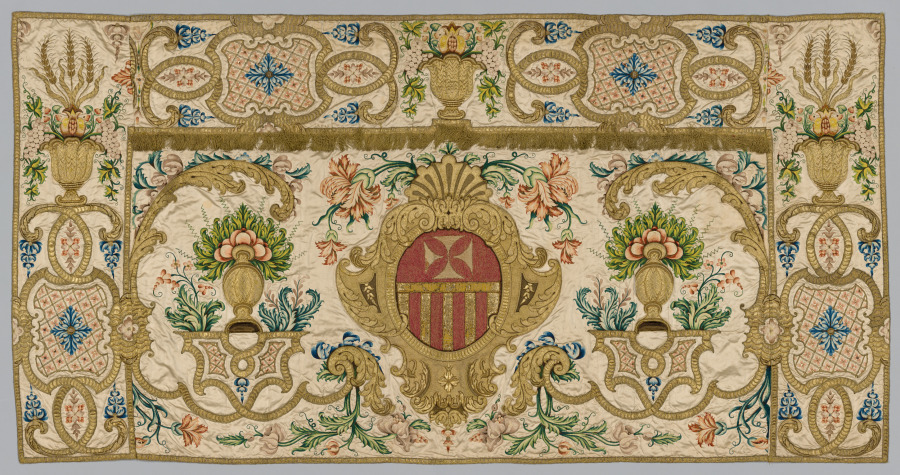
Embroidered Front of an Altar (1600s–1700s) is in the Cleveland Museum of Art collection.
The work and its context
The museum's open-access catalogue describes the work:
This spectacular cloth with raised three-dimensional embroidery embellished the front of an altar. Lavishly applied gilt-metal thread creates architectural embellishments enhanced by grand vases displaying sheaves of wheat in the upper corners and bunches of grapes in the center of the fringed over-frontal, referring to the bread and wine of the Mass. The central coat of arms represents the Order of the Blessed Virgin Mary of Mercy, a Roman Catholic mendicant order established in 1218 by Saint Peter Nolasco in the city of Barcelona, Spain, then in the principality of Catalonia (crown of Aragon).
Object facts
- Title: Embroidered Front of an Altar
- Date: 1600s–1700s
- Culture: Italy or Spain
- Type: Embroidery
- Technique: Satin and silk: embroidery
- Dimensions: Overall: 108 x 209.5 cm (42 1/2 x 82 1/2 in.)
- Collection: T - Ecclesiastical
- Department: Textiles
- Accession number: 1916.901
Collection credit
Gift of Mr. and Mrs. J. H. Wade
Further reading listed by the museum
- "The Relation of the Museum to Local Industry." The Bulletin of the Cleveland Museum of Art 5, no. 10 (1918): 122-131.
- "Exhibitions." Cleveland Art: Cleveland Museum of Art Members Magazine 56, no. 6 (November/December 2016): 4.
View the collection record
See the museum's photographs and full catalogue entry. Catalogue text is reproduced from the Cleveland Museum of Art's open-access data, with HTML formatting removed. This object and its supplied image are designated CC0.
Sources
More in Lifestyle
Keep reading


