Embroidered quilt with pomegranates and tulips (1600s-1700s): Art, History and Details
Embroidered quilt with pomegranates and tulips at the Cleveland Museum of Art: 1600s-1700s, plain weave: linen; embroidery, running stitch: silk. Explore the work's context, creator attribution and collection history.
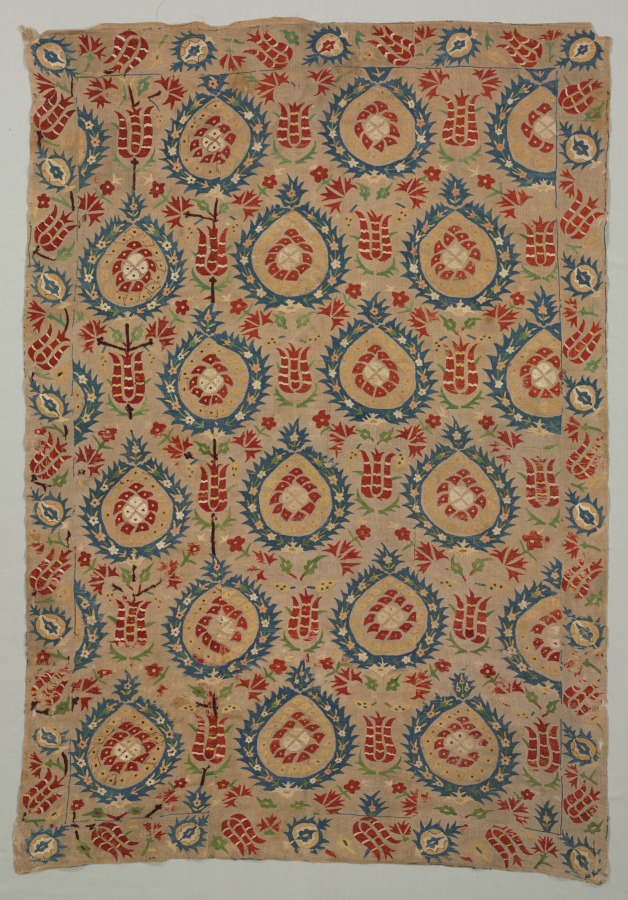
Embroidered quilt with pomegranates and tulips (1600s-1700s) is in the Cleveland Museum of Art collection.
The work and its context
The museum's open-access catalogue describes the work:
In Turkey, embroidered motifs were often adapted from Ottoman court art, especially luxury silks. Even the same six colors of silk thread were used: crimson or red, blue, green, and brown/black, plus yellow and white that replaced costly gilt- and silver-metal thread. In a typically bold style, pomegranates are framed by serrated leaves. Most of the original dark brown silk thread of the floral stems has disintegrated, revealing black ink outlines on the linen ground.
Object facts
- Title: Embroidered quilt with pomegranates and tulips
- Date: 1600s-1700s
- Culture: Turkey
- Type: Embroidery
- Technique: plain weave: linen; embroidery, running stitch: silk
- Dimensions: Average: 194.3 x 137.2 cm (76 1/2 x 54 in.)
- Collection: T - Islamic
- Department: Textiles
- Accession number: 1916.1300
Collection credit
Gift of Mr. and Mrs. J. H. Wade
Further reading listed by the museum
- Mackie, Louise W. Symbols of Power: Luxury Textiles from Islamic Lands, 7th-21st Century. Cleveland; New Haven: Cleveland Museum of Art; Yale University Press, 2015.
View the collection record
See the museum's photographs and full catalogue entry. Catalogue text is reproduced from the Cleveland Museum of Art's open-access data, with HTML formatting removed. This object and its supplied image are designated CC0.
Sources
More in Lifestyle
Keep reading