Embroidered towel (1800s): Art, History and Details
Embroidered towel at the Cleveland Museum of Art: 1800s, plain weave: linen; embroidery, double-running stitch: silk, gilt-metal strips and thread. Explore the work's context, creator attribution and collection history.
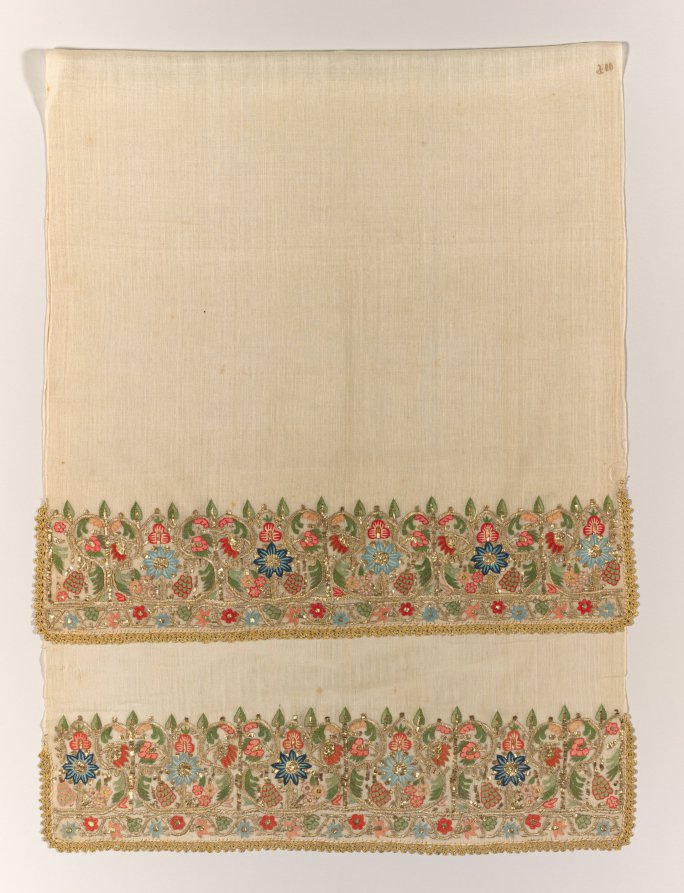
Embroidered towel (1800s) is in the Cleveland Museum of Art collection.
The work and its context
The museum's open-access catalogue describes the work:
Fine Turkish towels with beautiful floral decoration embroidered across each end are often reversible, and their quality revealed the owner’s wealth and status. A lady was required by Turkish etiquette to use a napkin “daintily over the tips of her fingers,” lest she lose her social standing. Towels were not only essential components of everyday life but also gifts, prizes, and decorations. Embroideries could also depict images of daily life. Colorful tents and buildings in floral landscapes, here enriched with shiny gilt-metal strips, adorn the four sides of a head scarf that was worn either folded or unfolded and fastened beneath the chin. Square embroideries also served to wrap gifts, letters, and objects; the 19th-century English traveler Charles White commented that “no present is made . . . unless folded in a handkerchief, embroidered cloth, or piece of gauze. The more rich the envelope, the higher the compliment to the receiver.”
Object facts
- Title: Embroidered towel
- Date: 1800s
- Culture: Turkey
- Type: Embroidery
- Technique: plain weave: linen; embroidery, double-running stitch: silk, gilt-metal strips and thread
- Dimensions: Average: 129.5 x 55.9 cm (51 x 22 in.)
- Collection: T - Islamic
- Department: Textiles
- Accession number: 1916.1251
Collection credit
Gift of Mr. and Mrs. J. H. Wade
Further reading listed by the museum
- Mackie, Louise W. Symbols of Power: Luxury Textiles from Islamic Lands, 7th-21st Century. Cleveland; New Haven: Cleveland Museum of Art; Yale University Press, 2015.
View the collection record
See the museum's photographs and full catalogue entry. Catalogue text is reproduced from the Cleveland Museum of Art's open-access data, with HTML formatting removed. This object and its supplied image are designated CC0.
Sources
More in Lifestyle
Keep reading