Embroidery from a Cloud Collar: Ocean, Rocks, and Peonies (1300s): Art, History and Details
Embroidery from a Cloud Collar: Ocean, Rocks, and Peonies at the Cleveland Museum of Art: 1300s, silk and silver thread, silvered paper; needleloop embroidery. Explore the work's context, creator attribution and collection history.
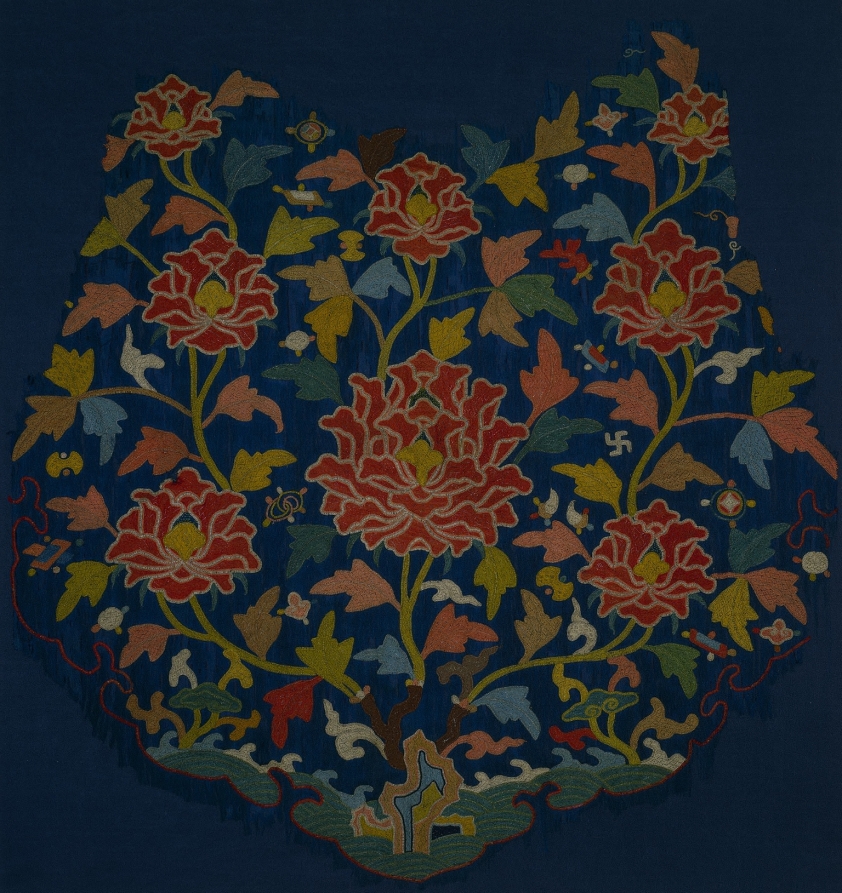
Embroidery from a Cloud Collar: Ocean, Rocks, and Peonies (1300s) is in the Cleveland Museum of Art collection.
The work and its context
The museum's open-access catalogue describes the work:
Against a deep blue satin ground, a peony tree emerges from an undulating sea. This embroidery was made using the needle looping technique, in which rows of detached loops are worked over silvered paper, attaching the ground only along the contours of the design. The design is filled with auspicious symbols, including the peony symbolizing wealth and honor, and the rock (shoushi 壽石) symbolizing longevity. There are small Buddhist symbols among the flowers, including the wheel of the law, a pair of conch shells representing the sounds of the Buddha’s teachings, and a swastika, an auspicious symbol signifying good fortune introduced into China from India with Buddhism.
Object facts
- Title: Embroidery from a Cloud Collar: Ocean, Rocks, and Peonies
- Date: 1300s
- Culture: China, Yuan dynasty (1271-1368) - early Ming dynasty (1368-1644)
- Type: Embroidery
- Technique: silk and silver thread, silvered paper; needleloop embroidery
- Dimensions: Overall: 63.8 x 60 cm (25 1/8 x 23 5/8 in.); Mounted: 69.8 x 67.3 cm (27 1/2 x 26 1/2 in.)
- Collection: Textiles
- Department: Textiles
- Accession number: 1993.10
A detail from the museum
Judging from the border on the lower portion, this fragment is most of one lobe of a cloud-collar medallion. Each of the three other original sections would have been embroidered with the same design.
Collection credit
Purchase from the J. H. Wade Fund
Further reading listed by the museum
- "1993 Annual Report." The Bulletin of the Cleveland Museum of Art 81, no. 6 (1994): 143–218.
- Watt, James C. Y., Anne E. Wardwell, and Morris Rossabi. When silk was gold: Central Asian and Chinese textiles. New York: Metropolitan Museum of Art in cooperation with the Cleveland Museum of Art: Distributed by H.N. Abrams, 1997.
- Chen, Juanjuan, Nengfu Huang, Wenying Li, and Hao Peng. Chinese Silks. Edited by Dieter Kuhn and Feng Zhao. New Haven, CT: Yale University Press, 2012.
View the collection record
See the museum's photographs and full catalogue entry. Catalogue text is reproduced from the Cleveland Museum of Art's open-access data, with HTML formatting removed. This object and its supplied image are designated CC0.
Sources
More in Lifestyle
Keep reading