En no Gyōja (1200s): Art, History and Details
En no Gyōja at the Cleveland Museum of Art: 1200s, wood. Explore the work's context, creator attribution and collection history.
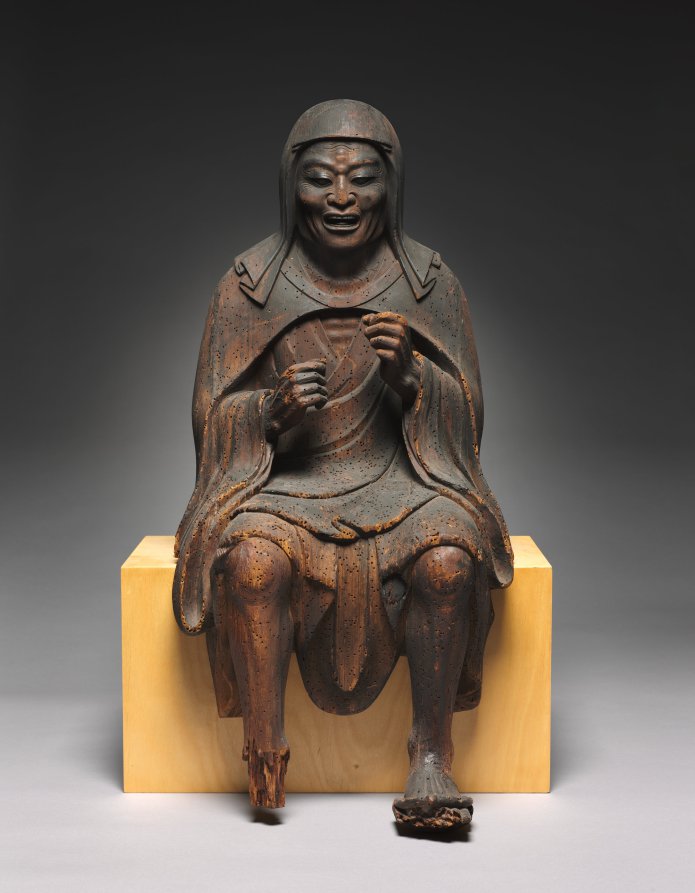
En no Gyōja (1200s) is in the Cleveland Museum of Art collection.
The work and its context
The museum's open-access catalogue describes the work:
This Buddhist monk is known as En no Gyōja, or “En the Ascetic” (legendarily 634–701), who is said to have founded Shugendō, a style of religious practice focused on performing challenging, rigorous tests of courage and devotion in mountainous settings.
Object facts
- Title: En no Gyōja
- Date: 1200s
- Culture: Japan, Kamakura period (1185–1333)
- Type: Sculpture
- Technique: wood
- Dimensions: Average: 74.9 cm (29 1/2 in.)
- Collection: Japanese Art
- Department: Japanese Art
- Accession number: 1975.65
A detail from the museum
This sculpture was once flanked by the demons Zenki and Koki (CMA 2012.40).
Collection credit
Purchase from the J. H. Wade Fund
Further reading listed by the museum
- Lee, Sherman E. “The Year in Review for 1975.” The Bulletin of the Cleveland Museum of Art 63, no. 2 (February 1976): 31–71.
- Lee, Sherman E. “Varieties of Portraiture in Chinese and Japanese Art.” The Bulletin of the Cleveland Museum of Art 64, no. 4 (April 1977): 118–36.
- The Cleveland Museum of Art. Handbook of the Cleveland Museum of Art/1978. Cleveland, OH: The Cleveland Museum of Art, 1978.
View the collection record
See the museum's photographs and full catalogue entry. Catalogue text is reproduced from the Cleveland Museum of Art's open-access data, with HTML formatting removed. This object and its supplied image are designated CC0.
Sources
More in Lifestyle
Keep reading