End-blown Flute (Hitoyogiri) (late 1800s): Art, History and Details
End-blown Flute (Hitoyogiri) at the Cleveland Museum of Art: late 1800s, Lacquered bamboo with gold and silver maki-e (sprinkled powder designs). Explore the work's context, creator attribution and collection history.
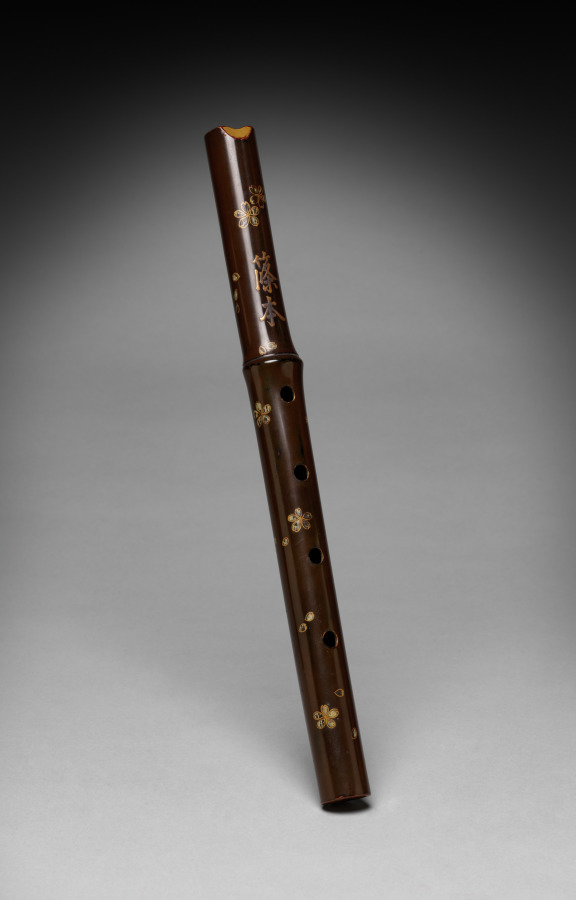
End-blown Flute (Hitoyogiri) (late 1800s) is in the Cleveland Museum of Art collection.
The work and its context
The museum's open-access catalogue describes the work:
The hitoyogiri 一節切 is considered one type of shakuhachi 尺八 bamboo flute and was popular in the 16th and 17th centuries. It is smaller and of weaker sound than the better known fuke 普化, and was thus known as a "small bamboo" or kotake 小竹, during a brief 19th-century revival. The node of the bamboo is positioned between the four finger holes on the front, and the thumb hole at the top of the back. This one has a design of cherry blossoms and scattered petals.
Object facts
- Title: End-blown Flute (Hitoyogiri)
- Date: late 1800s
- Culture: Japan, Meiji period (1868–1912)
- Type: Musical Instrument
- Technique: Lacquered bamboo with gold and silver maki-e (sprinkled powder designs)
- Dimensions: 33.5 x 2.6 cm (13 3/16 x 1 in.)
- Collection: Japanese Art
- Department: Japanese Art
- Accession number: 1921.914
A detail from the museum
The name of this flute, hitoyogiri 一節切 comes from the fact that it has a single node in the bamboo from which it is made.
Collection credit
Gift of Mr. and Mrs. Henry F. Lyman
View the collection record
See the museum's photographs and full catalogue entry. Catalogue text is reproduced from the Cleveland Museum of Art's open-access data, with HTML formatting removed. This object and its supplied image are designated CC0.
Sources
More in Lifestyle
Keep reading