Engaged Capital with Birds and Dragons (late 1100s): Art, History and Details
Engaged Capital with Birds and Dragons at the Cleveland Museum of Art: late 1100s, limestone. Explore the work's context, creator attribution and collection history.
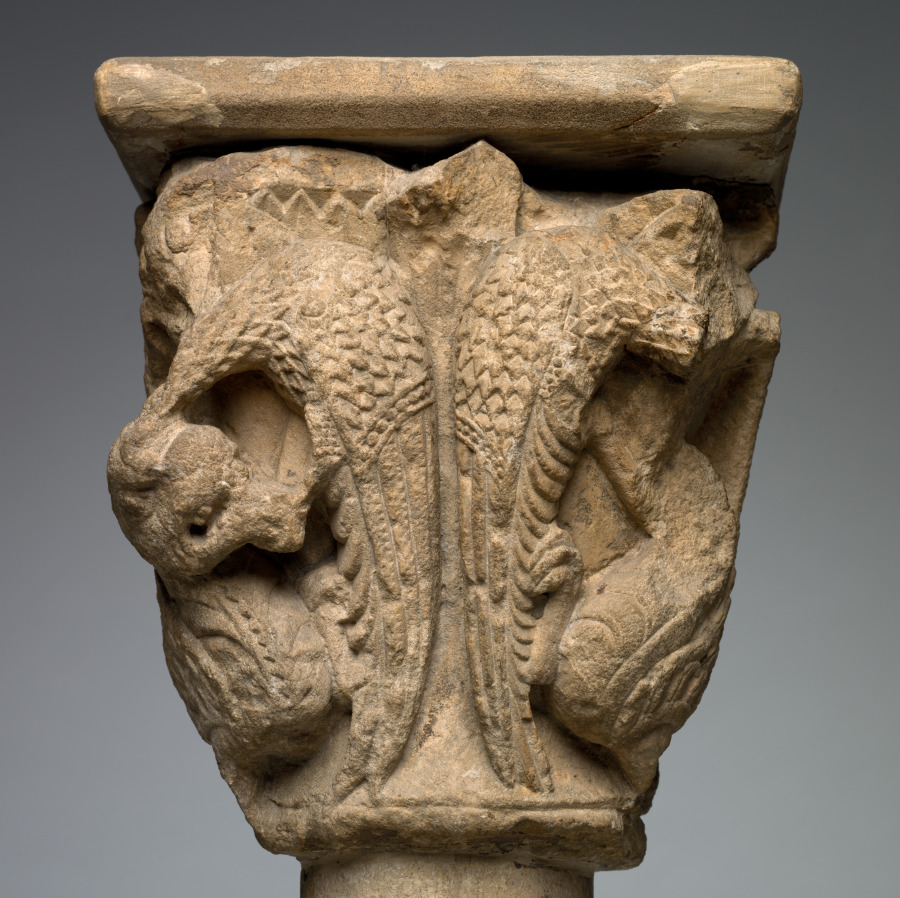
Engaged Capital with Birds and Dragons (late 1100s) is in the Cleveland Museum of Art collection.
The work and its context
The museum's open-access catalogue describes the work:
Monstrous images were prevalent in the decoration of religious buildings during the Middle Ages. Such images must have impressed, perhaps even terrified, the monks and visitors who spent much of their time within the cloister or church, a place of prayer, contemplation, and reflection. Scholars have speculated how such images would have been received by the people given the ubiquity of monsters in medieval society. The carved monsters, often symbolizing vice and retribution for sin, were possibly designed to provoke a range of emotional responses including laughter, wonder, surprise, fear, and shock. This striking imagery must have had a strong impact, which in turn led Saint Bernard of Clairvaux (1090–1153), the spiritual head of the Cistercian order, to admonish their use as distracting from prayer.
Object facts
- Title: Engaged Capital with Birds and Dragons
- Date: late 1100s
- Culture: Western France, Bordelais or Dordogne, late 12th Century
- Type: Sculpture
- Technique: limestone
- Dimensions: Overall: 28 x 26.1 x 20.7 cm (11 x 10 1/4 x 8 1/8 in.)
- Collection: MED - Romanesque
- Department: Medieval Art
- Accession number: 1916.1985
Collection credit
Gift of the John Huntington Art and Polytechnic Trust
View the collection record
See the museum's photographs and full catalogue entry. Catalogue text is reproduced from the Cleveland Museum of Art's open-access data, with HTML formatting removed. This object and its supplied image are designated CC0.
Sources
More in Lifestyle
Keep reading