Evening Snow at Kambara (number sixteen of the series Fifty-three Stations of the Tokaido) (1833): Art, History and Details
Evening Snow at Kambara (number sixteen of the series Fifty-three Stations of the Tokaido) at the Cleveland Museum of Art: 1833, color woodblock print. Explore the work's context, creator attribution and collection history.
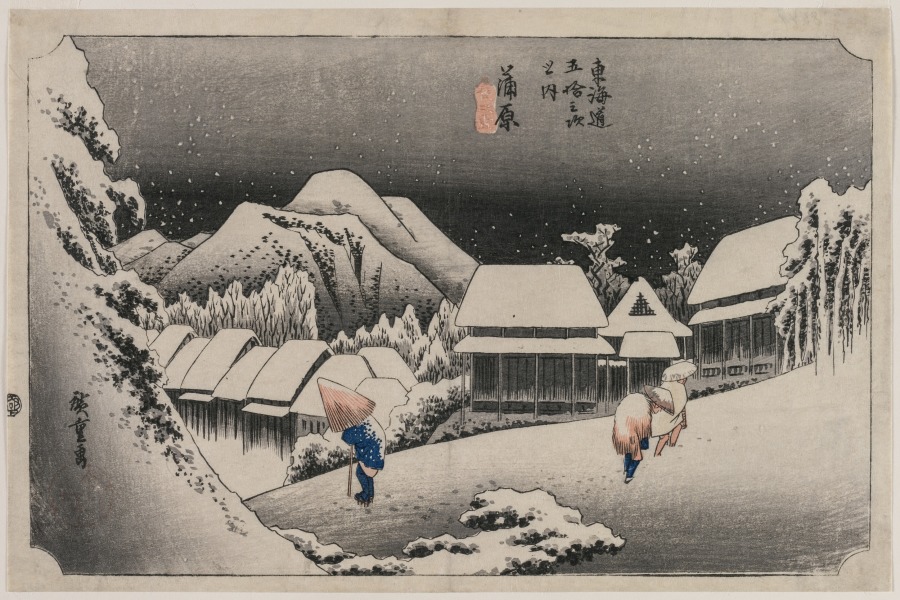
Evening Snow at Kambara (number sixteen of the series Fifty-three Stations of the Tokaido) (1833) is in the Cleveland Museum of Art collection. The museum's creator attribution is Utagawa Hiroshige (Japanese, 1797–1858).
The work and its context
The museum's open-access catalogue describes the work:
The coastal town of Kambara rarely experiences snowfall. Illustrating falling snow is particularly suited to woodblock prints. The snowflakes are created by carving their shapes out of the woodblock. When the surface of the block is inked and printed, the carved areas are represented by the unprinted white paper. This print may be the first by Hiroshige to depict falling snow.
Object facts
- Title: Evening Snow at Kambara (number sixteen of the series Fifty-three Stations of the Tokaido)
- Date: 1833
- Creator attribution: Utagawa Hiroshige (Japanese, 1797–1858)
- Culture: Japan, Edo period (1615–1868)
- Type: Print
- Technique: color woodblock print
- Dimensions: Sheet: 22.6 x 35.5 cm (8 7/8 x 14 in.)
- Collection: Japanese Art
- Department: Japanese Art
- Accession number: 1985.317
Collection credit
The Kelvin Smith Collection, given by Mrs. Kelvin Smith
Further reading listed by the museum
- “Checklist of the Kelvin Smith Bequest.” The Bulletin of the Cleveland Museum of Art 75, no. 7 (September 1988): 292–295.
View the collection record
See the museum's photographs and full catalogue entry. Catalogue text is reproduced from the Cleveland Museum of Art's open-access data, with HTML formatting removed. This object and its supplied image are designated CC0.
Sources
More in Lifestyle
Keep reading