Ewer (aiguière) (c. 1817): Art, History and Details
Ewer (aiguière) at the Cleveland Museum of Art: c. 1817, silver gilt. Explore the work's context, creator attribution and collection history.
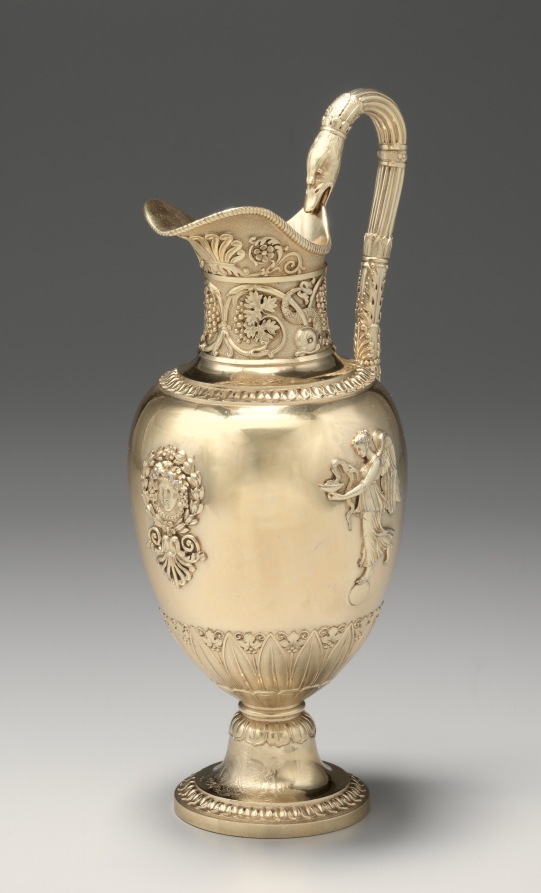
Ewer (aiguière) (c. 1817) is in the Cleveland Museum of Art collection. The museum's creator attribution is Jean Baptiste Claude Odiot (French).
The work and its context
The museum's open-access catalogue describes the work:
Jean-Baptiste-Claude Odiot’s reputation stretched internationally. Commissioned by Russian count Nikolei Demidoff, this ewer was one part of an extensive silver dinner service. Decorated with motifs of classical antiquity, this object’s Greco-Roman silhouette, grape vine frieze, raised mythological figures, and sinuous swan’s neck handle were likely inspired by the designs of Charles Percier and Pierre-François Fontaine, architects of Napoleon I.
Object facts
- Title: Ewer (aiguière)
- Date: c. 1817
- Creator attribution: Jean Baptiste Claude Odiot (French)
- Culture: France, 19th century
- Type: Silver
- Technique: silver gilt
- Dimensions: Overall: 24.6 x 11.6 x 9.9 cm (9 11/16 x 4 9/16 x 3 7/8 in.)
- Collection: Decorative Arts
- Department: Decorative Art and Design
- Accession number: 1980.183
A detail from the museum
The coat of arms on the foot of this ewer belongs to the count Alfred de la Chapelle who owned this silver dinner service during the second half of the 19th century.
Collection credit
Purchase from the J. H. Wade Fund
Further reading listed by the museum
- Lee, Sherman E. “The Year in Review for 1980.” The Bulletin of the Cleveland Museum of Art 68, no. 6 (June 1981): 163–219.
View the collection record
See the museum's photographs and full catalogue entry. Catalogue text is reproduced from the Cleveland Museum of Art's open-access data, with HTML formatting removed. This object and its supplied image are designated CC0.
Sources
More in Lifestyle
Keep reading