Ewer with Spout in the Form of an Elephant with a Mahut (1–100 CE): Art, History and Details
Ewer with Spout in the Form of an Elephant with a Mahut at the Cleveland Museum of Art: 1–100 CE, bronze. Explore the work's context, creator attribution and collection history.
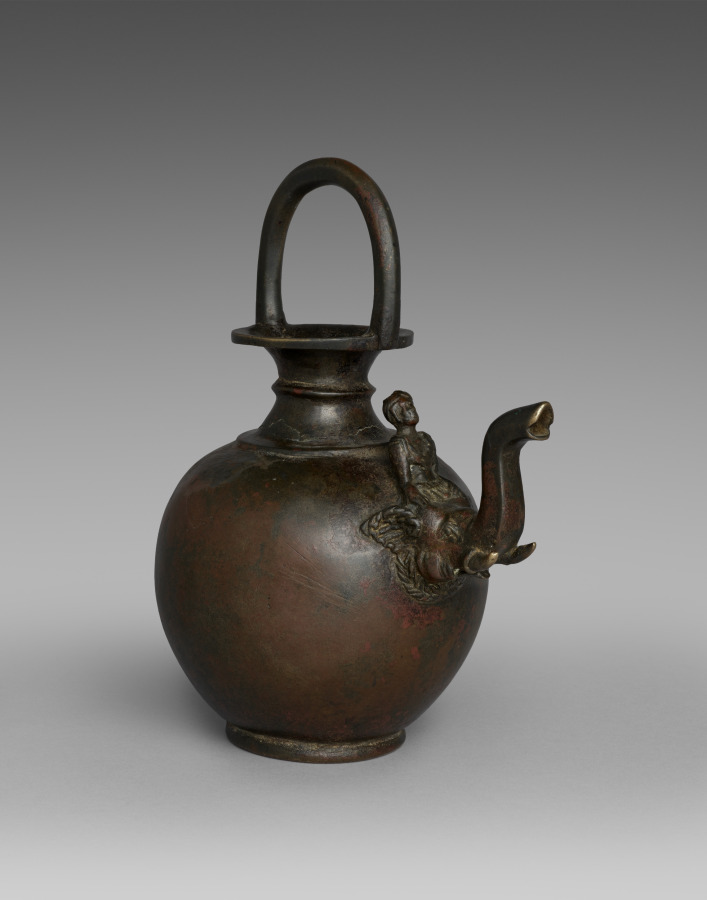
Ewer with Spout in the Form of an Elephant with a Mahut (1–100 CE) is in the Cleveland Museum of Art collection.
The work and its context
The museum's open-access catalogue describes the work:
This bulbous-shaped ewer with a low foot, narrow neck, and a loop handle attached to the top of the neck is cast in one piece. The neck, with an overhanging rim that widens at the mouth, is decorated with moldings at the bottom and in the center. The loop handle is octagonal in cross-section. Most interesting is the spout in the form of an elephant's head with a raised trunk and a mahout seated on its neck. The costume and turban worn by the rider are Kusana, while the elephant is indigenous to the region. Similar vessel shapes are commonly found in the Hellenistic world around the time of the Christian era; therefore, it is not surprising to find them within the sphere of Gandharan influence, which took its inspiration from the classical West. Among Sir John Marshall's excavations in Taxila, vessels of this type were found. Marshall suggested that the ewer with a loop handle at the top belongs to the category of traditional Indian vessels, while one with the handle on the side follows Greco-Roman prototypes. Similarly, the metal ewers excavated by Marshall were found in later strata in Sirkap and date to the first century AD, or even earlier. However, the earlier type seems to be the one with the vertical spout, so that the type of spout represented here probably dates later, around the first century AD. Furthermore, the elephant spout with Kusana rider suggests a date no earlier than the first century AD. A gold spout in the form of an elephant's head, originally attached to a glass vessel, was found in Begram and is presently at the Kabul Museum. The ewer was damaged when acquired. There were two irregular holes located on the globular sides of the vessel, just below the neck, with surrounding cracks. Although the holes were not very large, the damage was visually disturbing and prompted the restoration. The bottom of the ewer, now missing, was left as is, with no attempt to restore it.
Object facts
- Title: Ewer with Spout in the Form of an Elephant with a Mahut
- Date: 1–100 CE
- Culture: Afghanistan, Gandhara, probably Taxila or environs, early Kushan
- Type: Metalwork
- Technique: bronze
- Dimensions: Overall: 21 cm (8 1/4 in.); Diameter of base: 6.4 cm (2 1/2 in.)
- Collection: Indian Art - Kushan, Gandhara
- Department: Indian and Southeast Asian Art
- Accession number: 1982.66
Collection credit
John L. Severance Fund
Further reading listed by the museum
- Lee, Sherman E. "Year in Review for 1982." The Bulletin of the Cleveland Museum of Art 70, no. 1 (1983): 3-55.
- Czuma, Stanislaw J., and Rekha Morris. Kushan Sculpture: Images from Early India. Cleveland, OH: The Cleveland Museum of Art in cooperation with Indiana University Press, 1985.
- Sengupta, Arputha Rani. Buddhist Jewels in Mortuary Cult: Magic Symbols. Delhi: Agam Kala Prakashan, 2019.
View the collection record
See the museum's photographs and full catalogue entry. Catalogue text is reproduced from the Cleveland Museum of Art's open-access data, with HTML formatting removed. This object and its supplied image are designated CC0.
Sources
More in Lifestyle
Keep reading