Ewer with Triumph of Galatea (c. 1700): Art, History and Details
Ewer with Triumph of Galatea at the Cleveland Museum of Art: c. 1700, bronze. Explore the work's context, creator attribution and collection history.
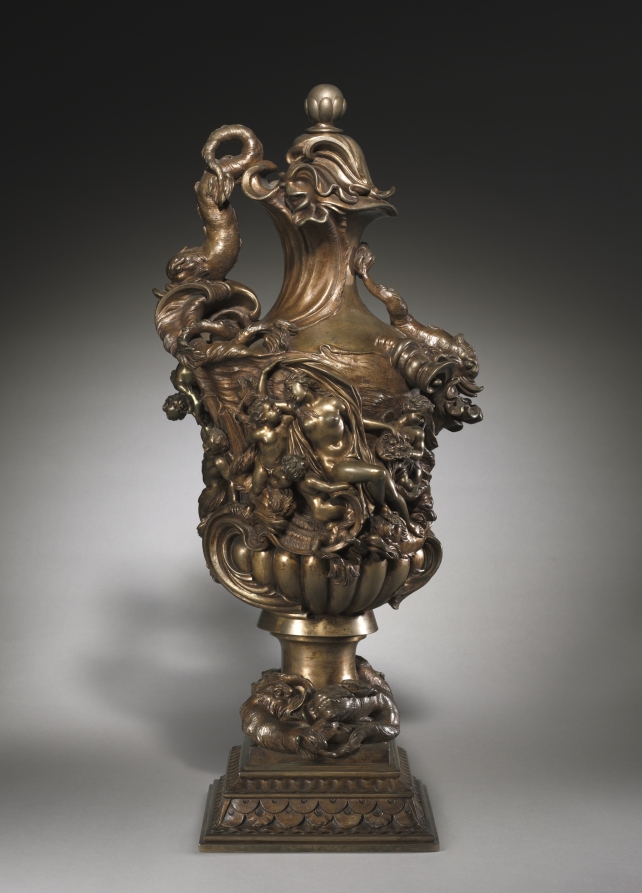
Ewer with Triumph of Galatea (c. 1700) is in the Cleveland Museum of Art collection. The museum's creator attribution is Massimiliano Soldani (Italian, 1656–1740).
The work and its context
The museum's open-access catalogue describes the work:
Upon discovering the sea nymph Galatea's infidelity, her betrothed, the Cyclops Polyphemus, pulverizes her lover Acis with a rock. In grief, Galatea turns his blood into a river and Acis becomes god of that river, which bears his name. Here Galatea escorts a swarm of sea creatures in celebration of Acis's apotheosis.
Object facts
- Title: Ewer with Triumph of Galatea
- Date: c. 1700
- Creator attribution: Massimiliano Soldani (Italian, 1656–1740)
- Culture: Italy, Florence
- Type: Sculpture
- Technique: bronze
- Dimensions: Overall: 81.5 x 35.5 x 26.5 cm (32 1/16 x 14 x 10 7/16 in.); Base: 8.9 x 25.9 x 26.5 cm (3 1/2 x 10 3/16 x 10 7/16 in.)
- Collection: Sculpture
- Department: European Painting and Sculpture
- Accession number: 1975.112
Collection credit
Severance and Greta Millikin Purchase Fund
Further reading listed by the museum
- Lee, Sherman E. “The Year in Review for 1975.” The Bulletin of the Cleveland Museum of Art 63, no. 2 (February 1976): 31–71.
- Biancotto, Filippo. "Il Culmine d'Ogni Pittorica Follia. Giovanni Antonio Fumiani e la Volta Della Chiesa di San Pantalon." In Soffitti Veneziani : La Decorazione Di Volte E Soffitti a Venezia Dal XV Al XVIII Secolo, Hans Aurenhammer, and Martina Frank, eds., 195-216. Roma, Venezia: Viella;/Centro Tedesco di Studi Veneziani, 2024.
View the collection record
See the museum's photographs and full catalogue entry. Catalogue text is reproduced from the Cleveland Museum of Art's open-access data, with HTML formatting removed. This object and its supplied image are designated CC0.
Sources
More in Lifestyle
Keep reading