Feline Incense Burner (1150–1200): Art, History and Details
Feline Incense Burner at the Cleveland Museum of Art: 1150–1200, Copper alloy, cast, engraved, chased, and pierced. Explore the work's context, creator attribution and collection history.
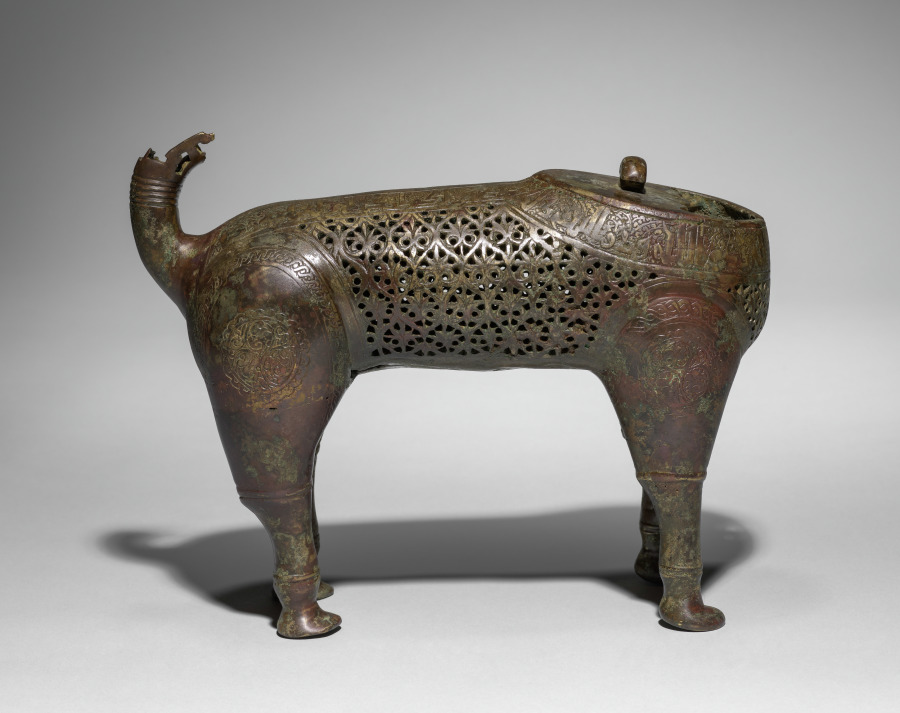
Feline Incense Burner (1150–1200) is in the Cleveland Museum of Art collection.
The work and its context
The museum's open-access catalogue describes the work:
In Iran during the 1000s and 1100s, vessels in the shape of animals gained popularity, especially as incense burners. Felines were favored in Persian art and this piece may represent a caracal, a type of lynx. The head of the creature was cast separately and is removable to fill its body with hot coals and incense. Qur’anic verses on the neck and spine remind worshippers to set work aside, attend prayer, and then disperse to seek God’s bounty. The diffusion of perfumed smoke through the burner’s pierced palmette design may have served as a sensorial reminder of this teaching.
Object facts
- Title: Feline Incense Burner
- Date: 1150–1200
- Culture: Iran, Khurasan, Seljuq period of Iran (1037–1194)
- Type: Metalwork
- Technique: Copper alloy, cast, engraved, chased, and pierced
- Dimensions: Overall: 35.5 x 11 cm (14 x 4 5/16 in.); Head: 17.8 x 9.5 x 12.5 cm (7 x 3 3/4 x 4 15/16 in.)
- Collection: Islamic Art
- Department: Islamic Art
- Accession number: 1948.308.a
A detail from the museum
A Kufic inscription against a background of scrolling arabesques runs along the back and neck of the feline form.
Collection credit
John L. Severance Fund
Further reading listed by the museum
- The Cleveland Museum of Art. The Cleveland Museum of Art Handbook. Cleveland, OH: The Cleveland Museum of Art, 1958.
- The Cleveland Museum of Art. Handbook of the Cleveland Museum of Art/1966. Cleveland, OH: The Cleveland Museum of Art, 1966.
- The Cleveland Museum of Art. Handbook of the Cleveland Museum of Art/1969. Cleveland, OH: The Cleveland Museum of Art, 1969.
View the collection record
See the museum's photographs and full catalogue entry. Catalogue text is reproduced from the Cleveland Museum of Art's open-access data, with HTML formatting removed. This object and its supplied image are designated CC0.
Sources
More in Lifestyle
Keep reading