Fibula with Solar Design (c. 700–675 BCE): Art, History and Details
Fibula with Solar Design at the Cleveland Museum of Art: c. 700–675 BCE, bronze. Explore the work's context, creator attribution and collection history.
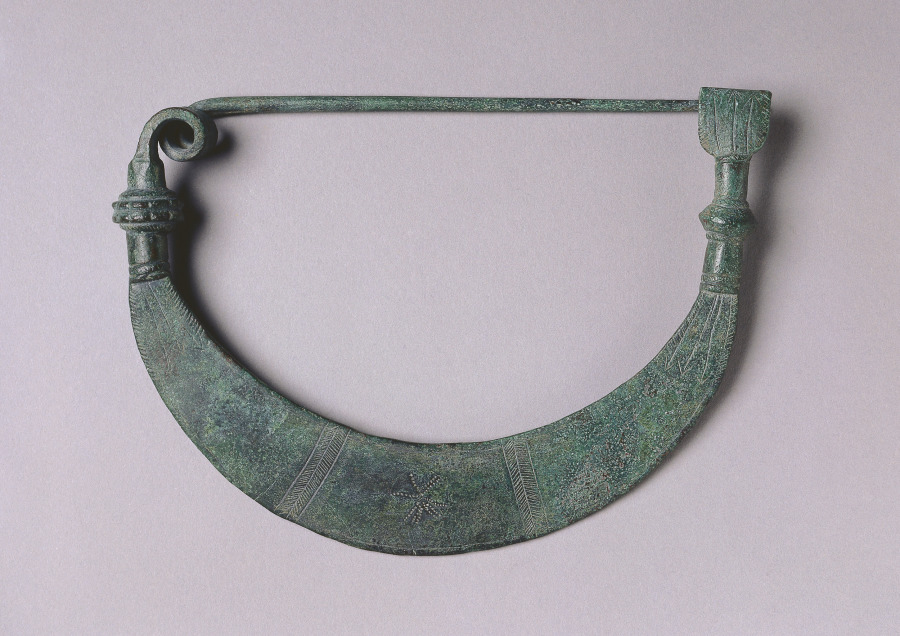
Fibula with Solar Design (c. 700–675 BCE) is in the Cleveland Museum of Art collection.
The work and its context
The museum's open-access catalogue describes the work:
The crescent body of this bronze fibula (brooch) features both incised and punched decoration. Three sets of three arrows have been interpreted as indicating the daily route of the sun, shown at the arc’s center as a series of radiating punch marks within a shallowly incised circle. When worn, the arc may have hung downward, a large ornamental addition to the functional pin used to secure its wearer’s clothing.
Object facts
- Title: Fibula with Solar Design
- Date: c. 700–675 BCE
- Culture: Greece, Boeotia
- Type: Metalwork
- Technique: bronze
- Dimensions: Overall: 15.4 x 11.2 cm (6 1/16 x 4 7/16 in.)
- Collection: GR - Greek
- Department: Greek and Roman Art
- Accession number: 1999.9
A detail from the museum
A fibula is an ancient safety pin that held garments in place.
Collection credit
John L. Severance Fund
Further reading listed by the museum
- Cleveland Museum of Art, Frederick E. Bidwell, and Leslie Cade. The CMA Companion: A Guide to the Cleveland Museum of Art. 2014.
- Sims, Lowery Stokes. The Persistence of Geometry: Form, Content, and Culture in the Collection of the Cleveland Museum of Art. Cleveland: Cleveland Museum of Art, 2006.
View the collection record
See the museum's photographs and full catalogue entry. Catalogue text is reproduced from the Cleveland Museum of Art's open-access data, with HTML formatting removed. This object and its supplied image are designated CC0.
Sources
More in Lifestyle
Keep reading