Figural Pendant (400–700): Art, History and Details
Figural Pendant at the Cleveland Museum of Art: 400–700, cast gold. Explore the work's context, creator attribution and collection history.
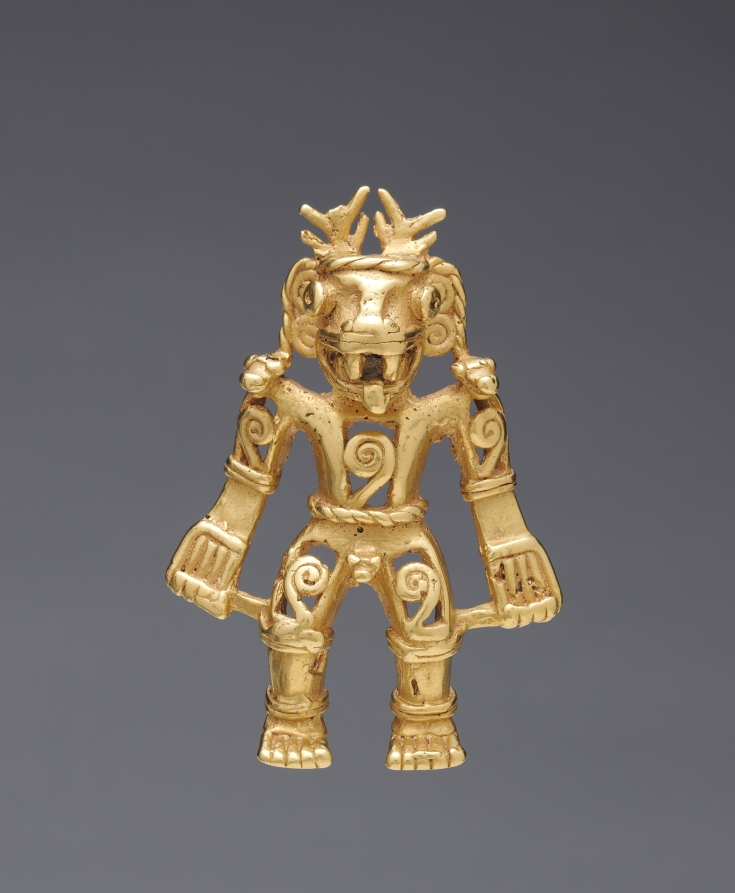
Figural Pendant (400–700) is in the Cleveland Museum of Art collection.
The work and its context
The museum's open-access catalogue describes the work:
This emphatically male figure combines a human body with a composite animal head. The antlers are the stag's; the snout, perhaps a snarling feline's; and the hair is formed of braided serpents whose heads hiss from the figure's shoulders. The extended tongue may convey aggression or perhaps death because dying animals are depicted with lolling tongues. Either condition is in keeping with the creature's ferocity.
Object facts
- Title: Figural Pendant
- Date: 400–700
- Culture: Panama, Darién or Venado Beach region, Openwork style, 5th-8th Century
- Type: Metalwork
- Technique: cast gold
- Dimensions: Overall: 7.8 x 5.3 x 2.3 cm (3 1/16 x 2 1/16 x 7/8 in.)
- Collection: AA - Intermediate Region
- Department: Art of the Americas
- Accession number: 1946.80
A detail from the museum
This ornament was made with the lost-wax casting technique.
Collection credit
Gift of Mrs. Benjamin P. Bole
Further reading listed by the museum
- Milliken, William. "Exhibition of Gold." The Bulletin of the Cleveland Museum of Art 34, no. 9 (November 1947): 211-212.
- Milliken, William. "New Accessions in Pre-Columbian Art." The Bulletin of the Cleveland Museum of Art 35, no. 8 (October 1948): 190-192.
- The Cleveland Museum of Art. The Cleveland Museum of Art Handbook. Cleveland, OH: The Cleveland Museum of Art, 1958.
View the collection record
See the museum's photographs and full catalogue entry. Catalogue text is reproduced from the Cleveland Museum of Art's open-access data, with HTML formatting removed. This object and its supplied image are designated CC0.
Sources
More in Lifestyle
Keep reading