Figurative harp (domu or kundi) (by 1928): Art, History and Details
Figurative harp (domu or kundi) at the Cleveland Museum of Art: by 1928, Wood, rawhide, plant fiber, metal, and glass bead. Explore the work's context, creator attribution and collection history.
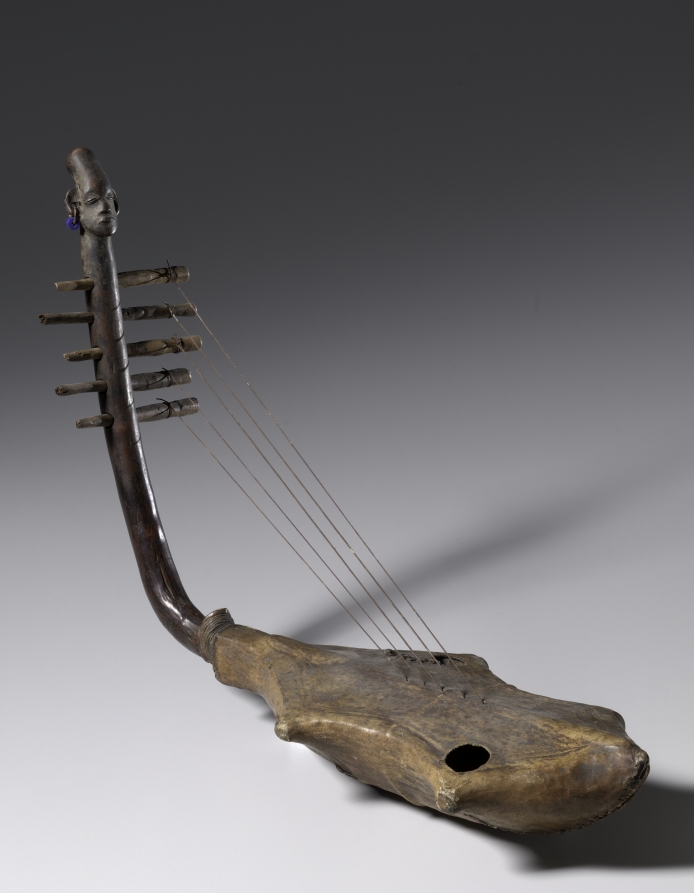
Figurative harp (domu or kundi) (by 1928) is in the Cleveland Museum of Art collection.
The work and its context
The museum's open-access catalogue describes the work:
Although five-stringed melodic harps with anthropomorphic decorations are found among different peoples in northern Congo, the elongated skull of this work is characteristic of the Mangbetu. Such instruments commonly served to accompany songs by either male or female musicians. Cleveland artist Paul Travis acquired this work and some others during his travels in Central Africa in 1928.
Object facts
- Title: Figurative harp (domu or kundi)
- Date: by 1928
- Culture: Africa, Central Africa, Democratic Republic of the Congo, Mangbetu-style maker
- Type: Musical Instrument
- Technique: Wood, rawhide, plant fiber, metal, and glass bead
- Dimensions: Handle: 36.9 cm (14 1/2 in.); Drum: 18.2 cm (7 3/16 in.)
- Collection: African Art
- Department: African Art
- Accession number: 1929.344
A detail from the museum
Musicians pluck the strings of this instrument with their fingers.
Collection credit
Gift of the African Art Sponsors of Karamu House
Further reading listed by the museum
- Petridis, Constantijn. South of the Sahara: selected works of African art. Cleveland: Cleveland Museum of Art, 2003.
- Petridis, Constantijn, et al. Fragments of the Invisible: The René and Odette Delenne Collection of Congo Sculpture. Cleveland, Ohio : Cleveland Museum of art ; Milan : 5 Continents Editions, 2013.
- Petridis, Constantine. "A World of Great Art for Everyone." In Representing Africa in American Art Museums: A Century of Collecting and Display. Kathleen Bickford Berzock and Christa Clarke, 104-121. Seattle: University of Washington Press, 2011.
View the collection record
See the museum's photographs and full catalogue entry. Catalogue text is reproduced from the Cleveland Museum of Art's open-access data, with HTML formatting removed. This object and its supplied image are designated CC0.
Sources
More in Lifestyle
Keep reading