Figure in a Litter (500–900 (Thermoluminescence date, 590–1090)): Art, History and Details
Figure in a Litter at the Cleveland Museum of Art: 500–900 (Thermoluminescence date, 590–1090), earthenware with colored slips. Explore the work's context, creator attribution and collection history.
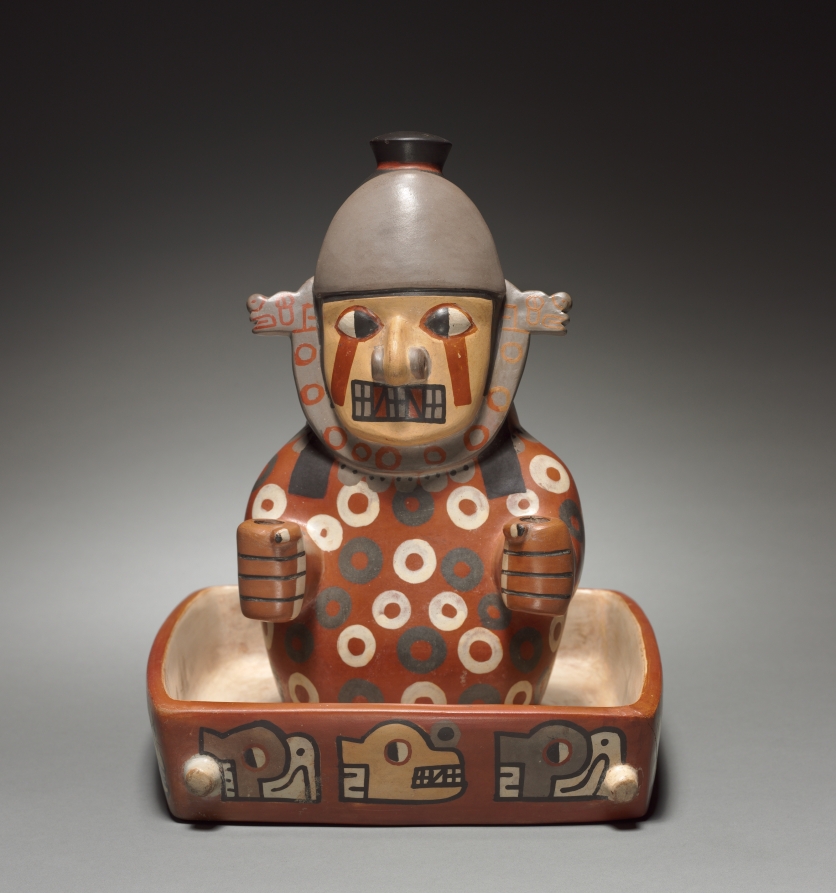
Figure in a Litter (500–900 (Thermoluminescence date, 590–1090)) is in the Cleveland Museum of Art collection.
The work and its context
The museum's open-access catalogue describes the work:
Whether a deity, ancestral mummy, or masked human, this figure signals power. The divided eyes and fangs are traits of supernatural beings. The hands are cupped around holes that once perhaps held staffs, symbols of human and divine authority. And the litter was a mode of travel reserved for those of high station; the knobs refer to poles that rested on the shoulders of human bearers.
Object facts
- Title: Figure in a Litter
- Date: 500–900 (Thermoluminescence date, 590–1090)
- Culture: Wari (Pachacamac) style, Middle Horizon, Epoch 2
- Type: Ceramic
- Technique: earthenware with colored slips
- Dimensions: Overall: 26.3 x 21.6 x 24.8 cm (10 3/8 x 8 1/2 x 9 3/4 in.)
- Collection: AA - Andes
- Department: Art of the Americas
- Accession number: 1997.1
Collection credit
Leonard C. Hanna Jr. Fund
Further reading listed by the museum
- Spielvogel, Rosaling Brueck. War: A Study in Tiahuanaco Style. vol. 1. (New Haven, CT: Dissertation Presented to the Faculty of the Graduate School, Yale University, 1951.)
- Sawyer, Alan R. Mastercraftsmen of Ancient Peru. [New York]: [Solomon R. Guggenheim Foundation], 1968.
- Lavalle, José Antonio de, and Werner Lang. Culturas precolombinas: Huari : Colección Arte y tresoros del Peru. Lima: Banco de Crédito del Peru en la Cultura, 1984.
View the collection record
See the museum's photographs and full catalogue entry. Catalogue text is reproduced from the Cleveland Museum of Art's open-access data, with HTML formatting removed. This object and its supplied image are designated CC0.
Sources
More in Lifestyle
Keep reading