Five Guineas: William & Mary (obverse); Crowned Shield of Arms (reverse) (1691): Art, History and Details
Five Guineas: William & Mary (obverse); Crowned Shield of Arms (reverse) at the Cleveland Museum of Art: 1691, gold. Explore the work's context, creator attribution and collection history.
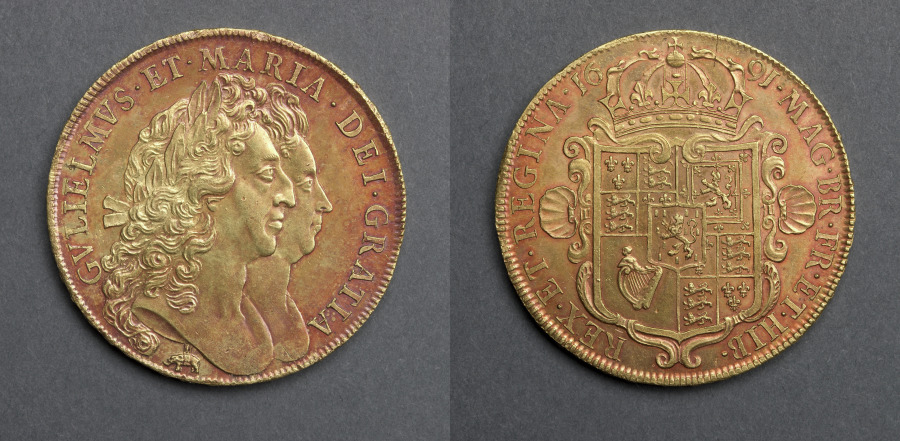
Five Guineas: William & Mary (obverse); Crowned Shield of Arms (reverse) (1691) is in the Cleveland Museum of Art collection.
The work and its context
The museum's open-access catalogue describes the work:
William of Orange-Nassau, and his wife Mary, daughter of James II, were proclaimed joint monarchs. Thus both their heads appear on their coinage. The only other instance of this in England is in the reign of Philip and Mary, 1554–58. Below them is a small elephant representing Guinea, the origin of the metal. William and Mary were invited to the English throne after James II had been driven from it, mainly because the people feared he was about to re-establish the Church of Rome.
Object facts
- Title: Five Guineas: William & Mary (obverse); Crowned Shield of Arms (reverse)
- Date: 1691
- Culture: England, William and Mary, 1688-1694
- Type: Coins
- Technique: gold
- Dimensions: Diameter: 3.6 cm (1 7/16 in.)
- Collection: MED - Numismatics
- Department: Medieval Art
- Accession number: 1969.201
A detail from the museum
The shield of arms includes Ireland, represented by a harp, and Scotland, represented by a lion.
Collection credit
The Norweb Collection
Further reading listed by the museum
- Cleveland Museum of Art, and Emery May Norweb. English Gold Coins, Ancient to Modern Times, On Loan to the Cleveland Museum of Art from the Norweb Collection. [Catalog. 1968.
View the collection record
See the museum's photographs and full catalogue entry. Catalogue text is reproduced from the Cleveland Museum of Art's open-access data, with HTML formatting removed. This object and its supplied image are designated CC0.
Sources
More in Lifestyle
Keep reading