Five-pronged Vajra Bell (Gokorei) (early 1300s): Art, History and Details
Five-pronged Vajra Bell (Gokorei) at the Cleveland Museum of Art: early 1300s, gilt bronze. Explore the work's context, creator attribution and collection history.
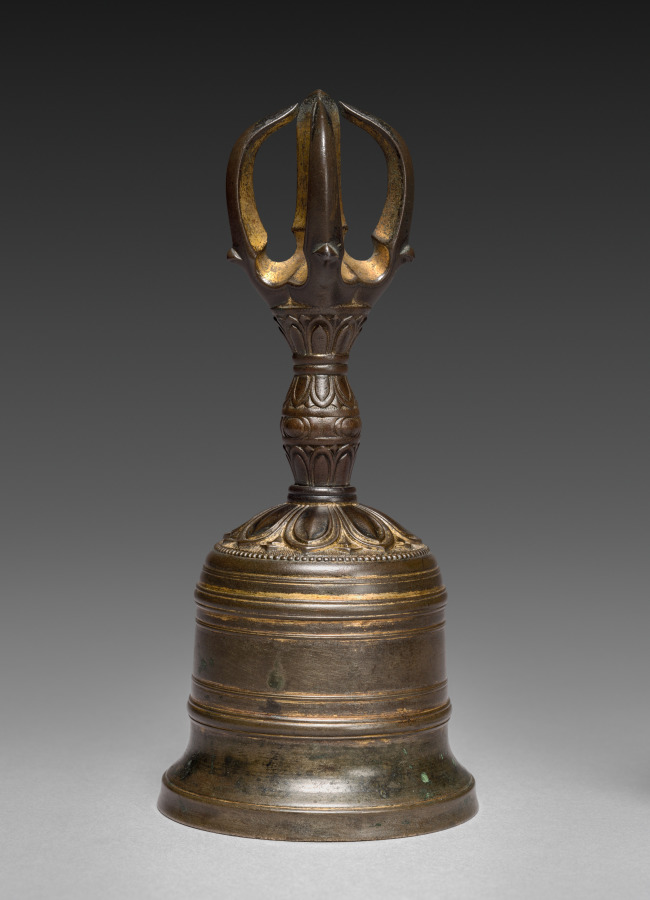
Five-pronged Vajra Bell (Gokorei) (early 1300s) is in the Cleveland Museum of Art collection.
The work and its context
The museum's open-access catalogue describes the work:
The five prongs of this bell symbolize the Buddhist “Five Perfections”—generosity, morality, patience, perseverance, and concentration. The mouth of the bell symbolizes the “Sixth Perfection” of wisdom. The bell was used in Japanese Esoteric Buddhist rituals along with vajra pestles, or kongōsho.
Object facts
- Title: Five-pronged Vajra Bell (Gokorei)
- Date: early 1300s
- Culture: Japan, Kamakura period (1185–1333)
- Type: Metalwork
- Technique: gilt bronze
- Dimensions: height: 16.7 cm (6 9/16 in.); Diameter: 7.5 cm (2 15/16 in.)
- Collection: Japanese Art
- Department: Japanese Art
- Accession number: 2016.38
A detail from the museum
Vajras are symbolic weapons, representing the properties of a diamond (indestructibility) and a thunderbolt (irresistible force), still used in Buddhist ceremonies today.
Collection credit
Lillian M. Kern Memorial Fund
Further reading listed by the museum
- Vilbar, Sinéad. “Acquisition Highlights 2016: Japanese Art.” Cleveland Art: Cleveland Museum of Art Members Magazine 57, no. 2 (March/April 2017): 18–19.
View the collection record
See the museum's photographs and full catalogue entry. Catalogue text is reproduced from the Cleveland Museum of Art's open-access data, with HTML formatting removed. This object and its supplied image are designated CC0.
Sources
More in Lifestyle
Keep reading