Five-pronged Vajra Pestle (Gokosho) (900s): Art, History and Details
Five-pronged Vajra Pestle (Gokosho) at the Cleveland Museum of Art: 900s, bronze. Explore the work's context, creator attribution and collection history.
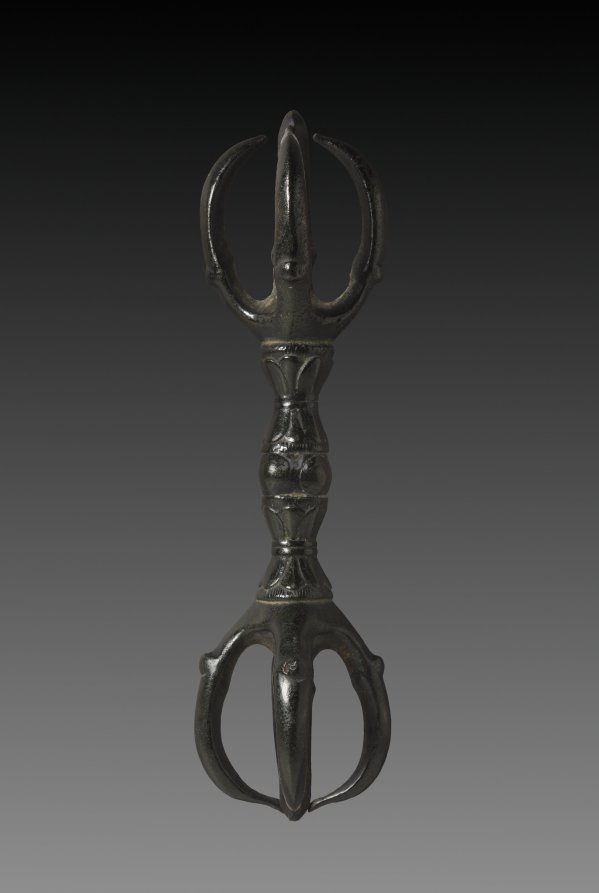
Five-pronged Vajra Pestle (Gokosho) (900s) is in the Cleveland Museum of Art collection.
The work and its context
The museum's open-access catalogue describes the work:
Resembling weapons wielded by deities described in the Vedas, ancient Indian religious scriptures, the vajra pestle (kongōsho) has long been used in Esoteric Buddhist rituals. The word vajra means diamond and thunderbolt in Sanskrit. Vajras are thus indestructible and powerful tools of Buddhism. The number of prongs has significance, with single-, three-, and five-pronged vajras being used for different purposes. The stylized thunderbolt known as a vajra also connotes the speed of lightning and the indestructible qualities of diamond to best describe the attributes of Tantra. Vajras are ubiquitous in tantric art and ritual practices. This example from the Heian period (784-1185) reveals the early spread of Tantra from India across China and Southeast Asia to enter Japan where it is known as Shingon. A Japanese monk named Kūkai founded the Shingon sect of Esoteric Buddhism after he received the texts and teachings from a Chinese tantric master. When he returned to Japan in 806, he founded the influential Shingon sect.
Object facts
- Title: Five-pronged Vajra Pestle (Gokosho)
- Date: 900s
- Culture: Japan, Heian period (794–1185)
- Type: Metalwork
- Technique: bronze
- Dimensions: Overall: 15 cm (5 7/8 in.)
- Collection: Japanese Art
- Department: Japanese Art
- Accession number: 1954.785
Collection credit
Gift of Dr. and Mrs. Sherman E. Lee
View the collection record
See the museum's photographs and full catalogue entry. Catalogue text is reproduced from the Cleveland Museum of Art's open-access data, with HTML formatting removed. This object and its supplied image are designated CC0.
Sources
More in Lifestyle
Keep reading