Flask in the Shape of a Fan (1600s): Art, History and Details
Flask in the Shape of a Fan at the Cleveland Museum of Art: 1600s, Imari ware porcelain, molded, carved, and glazed with overglaze enamel decoration. Explore the work's context, creator attribution and collection history.
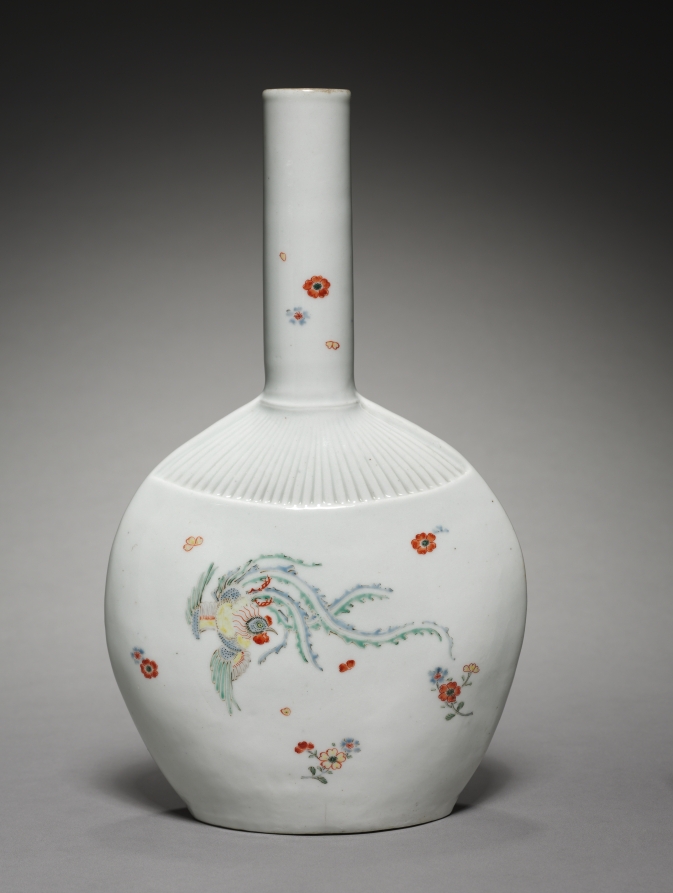
Flask in the Shape of a Fan (1600s) is in the Cleveland Museum of Art collection.
The work and its context
The museum's open-access catalogue describes the work:
Possibly used during the summer, this fan-shaped flask features a phoenix on one side and a tiny bird on the other. It is in the style called kakiemon (after the name of the artisan family). The style is common among Japanese export porcelain known as Imari ware (after the name of the port) or Arita ware (after the name of the city of production). The phoenix is an imaginary bird that generally symbolized the imperial family. The Japanese adapted representations of a long-tailed chicken (chobikei) or a long-tailed bird (onagatori) to the image of the phoenix. This kind of phoenix design appears in the high-quality art of Kano school screens as well as the decorative arts.
Object facts
- Title: Flask in the Shape of a Fan
- Date: 1600s
- Culture: Japan, Edo period (1615–1868)
- Type: Ceramic
- Technique: Imari ware porcelain, molded, carved, and glazed with overglaze enamel decoration
- Dimensions: Diameter: 19.4 cm (7 5/8 in.); Overall: 33.3 cm (13 1/8 in.)
- Collection: Japanese Art
- Department: Japanese Art
- Accession number: 1993.2
Collection credit
Severance and Greta Millikin Purchase Fund
Further reading listed by the museum
- “1993 Annual Report.” The Bulletin of the Cleveland Museum of Art 81, no. 6 (July 1994): 143–218.
- Cunningham, Michael R. Masterworks of Asian art. Cleveland, Ohio: Cleveland Museum of Art, 1998.
- Cleveland Museum of Art, and Sŏn Sŭng-hye. The Lure of Painted Poetry: Japanese and Korean Art. Cleveland: Cleveland Museum of Art, 2011.
View the collection record
See the museum's photographs and full catalogue entry. Catalogue text is reproduced from the Cleveland Museum of Art's open-access data, with HTML formatting removed. This object and its supplied image are designated CC0.
Sources
More in Lifestyle
Keep reading