Flint in the Form of a Bird (4000–3000 BCE): Art, History and Details
Flint in the Form of a Bird at the Cleveland Museum of Art: 4000–3000 BCE, tan-colored flint. Explore the work's context, creator attribution and collection history.
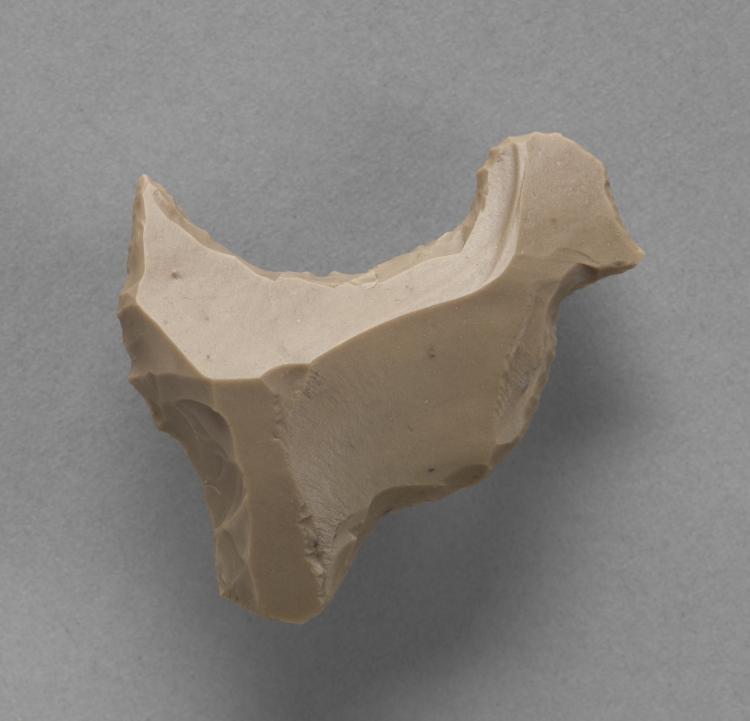
Flint in the Form of a Bird (4000–3000 BCE) is in the Cleveland Museum of Art collection.
The work and its context
The museum's open-access catalogue describes the work:
This flint is ground on one side and ripple-flaked on the other, indicating the date. Nonrepresentational flints were tools and weapons. Representational ones like this, however, were undoubtedly tomb gifts and never used. The type of bird represented is a Guinea fowl or quail. A number of Egyptian flints in this form are known although this one is one of the largest and is of exceptional quality.
Object facts
- Title: Flint in the Form of a Bird
- Date: 4000–3000 BCE
- Culture: Egypt, Predynastic (5000–2950 BCE), Naqada II–III (3650–3000 BCE)
- Type: Tools and Equipment
- Technique: tan-colored flint
- Dimensions: Overall: 5.2 x 5.2 cm (2 1/16 x 2 1/16 in.)
- Collection: Egypt - Predynastic
- Department: Egyptian and Ancient Near Eastern Art
- Accession number: 1995.40
A detail from the museum
The exact function of objects like this is unknown; it may have been an amulet or charm.
Collection credit
John L. Severance Fund
Further reading listed by the museum
- Cleveland Museum of Art. Annual Report. Cleveland, Ohio: The Museum, 1995.
- Berman, Lawrence M., and Kenneth J. Bohač. Catalogue of Egyptian Art: The Cleveland Museum of Art. Cleveland, OH: Cleveland Museum of Art, 1999
View the collection record
See the museum's photographs and full catalogue entry. Catalogue text is reproduced from the Cleveland Museum of Art's open-access data, with HTML formatting removed. This object and its supplied image are designated CC0.
Sources
More in Lifestyle
Keep reading