Flintlock Pistol (1700s): Art, History and Details
Flintlock Pistol at the Cleveland Museum of Art: 1700s, steel with traces of gilding; walnut stock. Explore the work's context, creator attribution and collection history.
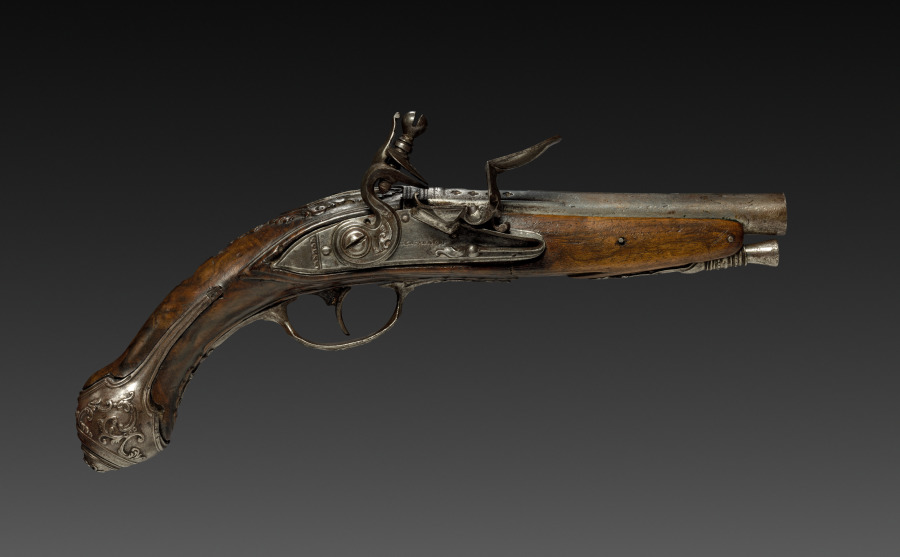
Flintlock Pistol (1700s) is in the Cleveland Museum of Art collection. The museum's creator attribution is Bortolo Agazzi (Italian); Lazaro Lazarino (Italian).
The work and its context
The museum's open-access catalogue describes the work:
The flintlock was the most popular style of lock in all of Europe in the mid 1600s through the 1700s except in Spain and Italy where the snaphance was more dominant. This pistol's shine comes from the gold that was applied to the steel shaft. This shiny surface is set off by the rich walnut stock. Upon close inspection, you can see areas of damage to the walnut and even a missing section of decoration on the rear of the handle.
Object facts
- Title: Flintlock Pistol
- Date: 1700s
- Creator attribution: Bortolo Agazzi (Italian); Lazaro Lazarino (Italian)
- Culture: Italy, Brescia, 18th century
- Type: Arms and Armor
- Technique: steel with traces of gilding; walnut stock
- Dimensions: Overall: 24.5 cm (9 5/8 in.); Barrel: 12.7 cm (5 in.); Bore: 1.2 cm (1/2 in.)
- Collection: MED - Arms & Armor
- Department: Medieval Art
- Accession number: 1916.45
A detail from the museum
The term flintlock is used to describe any firearm that uses a flint-striking ignition mechanism.
Collection credit
Gift of Mr. and Mrs. John L. Severance
Further reading listed by the museum
- Catalogue of Arms and Armour. Vol. 4, 17th to 19th century and a few pieces of iron work. [Boston, Massachusetts]: [Frank Gair Macomber], [1900-1915].
- Gilchrist, Helen Ives. A Catalogue of the Collection of Arms & Armor Presented to the Cleveland Museum of Art by Mr. and Mrs. John Long Severance; 1916-1923. Cleveland: Cleveland Museum of Art, 1924.
- Fliegel, Stephen N. Arms and Armor: The Cleveland Museum of Art. [Cleveland, Ohio]: The Museum, 1998.
View the collection record
See the museum's photographs and full catalogue entry. Catalogue text is reproduced from the Cleveland Museum of Art's open-access data, with HTML formatting removed. This object and its supplied image are designated CC0.
Sources
More in Lifestyle
Keep reading