Food Container (Gui) (600–500 BCE): Art, History and Details
Food Container (Gui) at the Cleveland Museum of Art: 600–500 BCE, bronze. Explore the work's context, creator attribution and collection history.
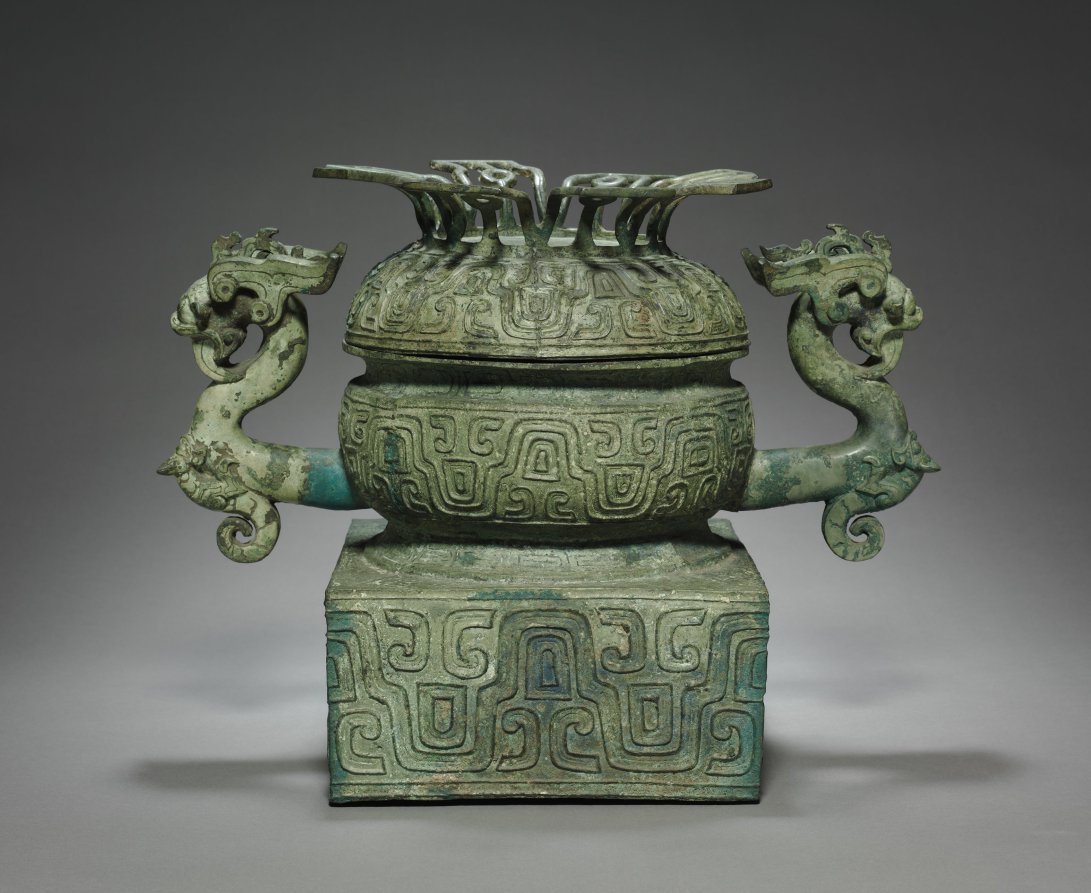
Food Container (Gui) (600–500 BCE) is in the Cleveland Museum of Art collection.
The work and its context
The museum's open-access catalogue describes the work:
Openwork and sculptural designs elaborately transform the silhouette of this gui, a ritual food vessel with a square pedestal. The design exudes motion, exuberance, and baroque characters to a stately vessel form. Lotus-petal openwork encircles the cover, reinforcing the linear rhythms of the undulating wave patterns on the body. Two lively dragons, with eyes and mouth wide open and tongue straight out, are accompanied by two felines to form the arched handles.
Object facts
- Title: Food Container (Gui)
- Date: 600–500 BCE
- Culture: China, Eastern Zhou dynasty (770–256 BCE), Spring and Autumn period (770–476 BCE)
- Type: Metalwork
- Technique: bronze
- Dimensions: Overall: 34.3 x 44.5 cm (13 1/2 x 17 1/2 in.)
- Collection: China - Zhou Dynasty
- Department: Chinese Art
- Accession number: 1974.73
A detail from the museum
This ritual food vessel likely held grain like rice, millet, or corn in rites for worshipping the ancestors.
Collection credit
Leonard C. Hanna Jr. Fund
Further reading listed by the museum
- Christie, Manson & Woods. The Frederick M. Mayer Collection of Chinese Art. 25 June 1974 sale.
- Lee, Sherman E. “The Year in Review for 1974.” The Bulletin of the Cleveland Museum of Art 62, no. 3 (1975): 62–103.
- The Cleveland Museum of Art. Handbook of the Cleveland Museum of Art/1978. Cleveland, OH: The Cleveland Museum of Art, 1978.
View the collection record
See the museum's photographs and full catalogue entry. Catalogue text is reproduced from the Cleveland Museum of Art's open-access data, with HTML formatting removed. This object and its supplied image are designated CC0.
Sources
More in Lifestyle
Keep reading