Footed Bowl (late 1100s–early 1200s): Art, History and Details
Footed Bowl at the Cleveland Museum of Art: late 1100s–early 1200s, fritware, pierced and underglaze painting. Explore the work's context, creator attribution and collection history.
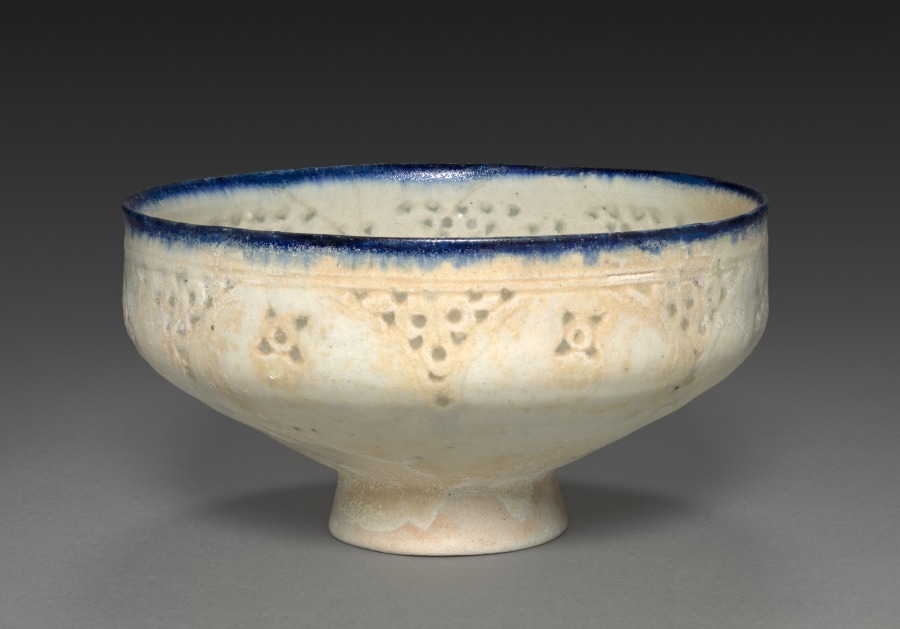
Footed Bowl (late 1100s–early 1200s) is in the Cleveland Museum of Art collection.
The work and its context
The museum's open-access catalogue describes the work:
Iranian potters created transparency by piercing and glazing frit-body walls. Here, triangles and rosettes decorate incised scallops beneath the blue rim. The footed shape is derived from Iranian metal bowls.
Object facts
- Title: Footed Bowl
- Date: late 1100s–early 1200s
- Culture: Iran, probably Kashan, Seljuq period, late 12-early 13th century
- Type: Ceramic
- Technique: fritware, pierced and underglaze painting
- Dimensions: Overall: 9.8 x 18.2 cm (3 7/8 x 7 3/16 in.)
- Collection: Islamic Art
- Department: Islamic Art
- Accession number: 1915.581
Collection credit
Gift of the John Huntington Art and Polytechnic Trust
Further reading listed by the museum
- Pope, Arthur Upham, and Theodore Bestermann. 1938. A Survey of Persian Art from Prehistoric Times to the Present. Edited by Phyllis Ackerman. London: Oxford University Press.
- Lane, Arthur. 1947. Early Islamic Pottery: Mesopotamia, Egypt and Persia. Faber Monographs on Pottery and Porcelain. London: Faber and Faber.
- Atil, Esin, and Fiftieth Anniversary Exhibition (3 : 1973 : Washington, D.C.). 1973. Ceramics from the World of Islam. Fiftieth Anniversary Exhibition / Freer Gallery of Art, 3. Washington: Smithsonian Institution.
View the collection record
See the museum's photographs and full catalogue entry. Catalogue text is reproduced from the Cleveland Museum of Art's open-access data, with HTML formatting removed. This object and its supplied image are designated CC0.
Sources
More in Lifestyle
Keep reading