Fork with Mule-Head Finial (375–425 CE): Art, History and Details
Fork with Mule-Head Finial at the Cleveland Museum of Art: 375–425 CE, silver. Explore the work's context, creator attribution and collection history.
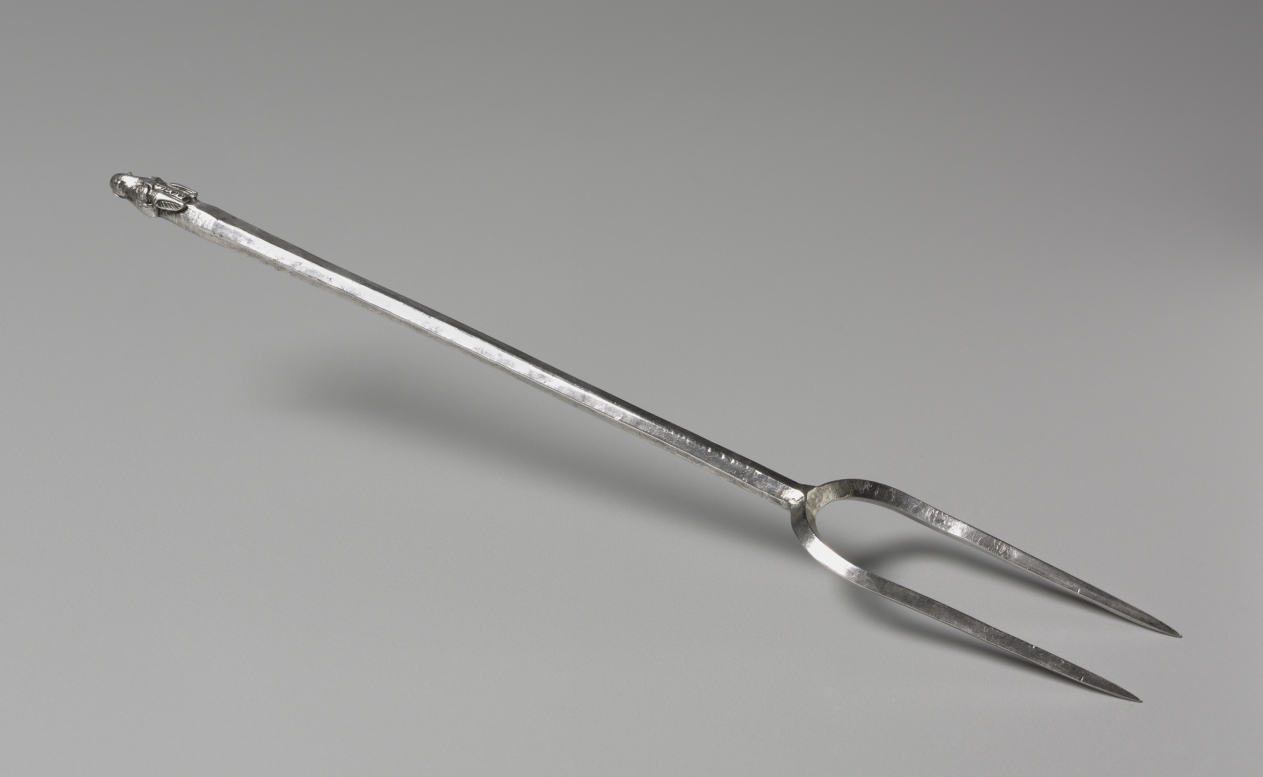
Fork with Mule-Head Finial (375–425 CE) is in the Cleveland Museum of Art collection.
The work and its context
The museum's open-access catalogue describes the work:
This two-tined silver fork has a faceted handle that terminates in a mule head, perhaps a nod to its use for meat— whether cooking, serving, or eating. Forks from the premodern Mediterranean are rare, only known through a small number of surviving examples. Extant forks are relatively large and often bronze, making this silver example still more rare.
Object facts
- Title: Fork with Mule-Head Finial
- Date: 375–425 CE
- Culture: Italy, Roman
- Type: Metalwork
- Technique: silver
- Dimensions: Overall: 0.5 x 20.4 cm (3/16 x 8 1/16 in.)
- Collection: GR - Roman
- Department: Greek and Roman Art
- Accession number: 1987.210
A detail from the museum
This fork served a utilitarian purpose as flatware in antiquity.
Collection credit
Gift of Mr. and Mrs. Quentin Alexander
Further reading listed by the museum
- Turner, Evan H. “The Year in Review for 1987.” The Bulletin of the Cleveland Museum of Art 75, no. 2 (1988): 65, no. 7.
- Parani, Maria G. Byzantine cutlery: an overview. Athēnai: Christianikē Archaiologikē Hetaireia, 2010.
View the collection record
See the museum's photographs and full catalogue entry. Catalogue text is reproduced from the Cleveland Museum of Art's open-access data, with HTML formatting removed. This object and its supplied image are designated CC0.
Sources
More in Lifestyle
Keep reading