Four-armed goddess, with hearts in margin (1900s): Art, History and Details
Four-armed goddess, with hearts in margin at the Cleveland Museum of Art: 1900s, ink and color on paper. Explore the work's context, creator attribution and collection history.
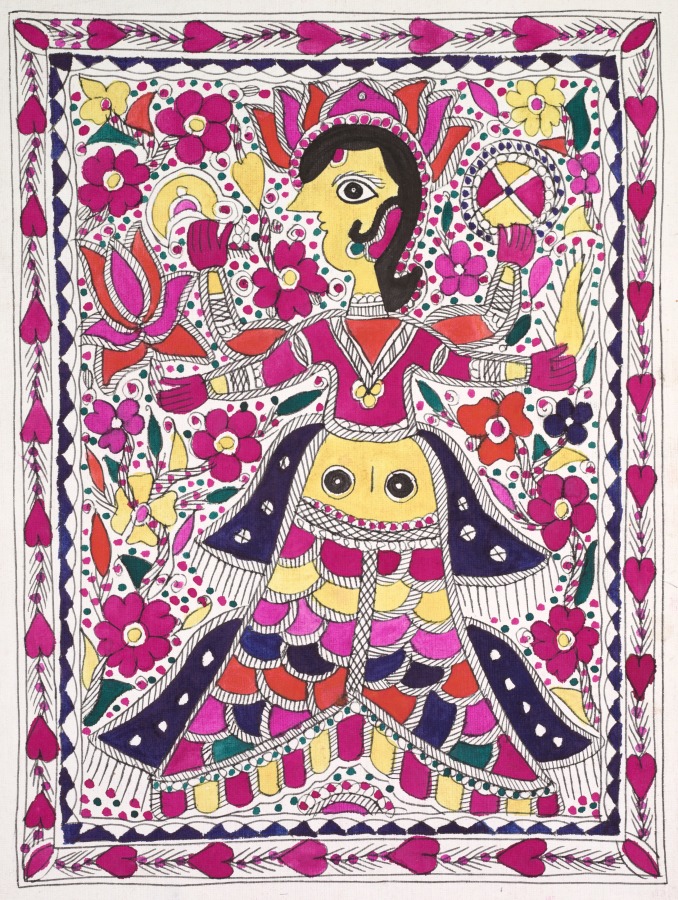
Four-armed goddess, with hearts in margin (1900s) is in the Cleveland Museum of Art collection.
The work and its context
The museum's open-access catalogue describes the work:
This goddess holds a lotus flower and a discus, along with two other unidentified objects. Historically, Madhubani paintings were murals created with brushes made of bamboo and cotton. They ornamented domestic spaces on the occasion of a festival or rite of passage in a woman's life, such as a birth or a wedding. In the wake of a drought in 1966, the All India Handicrafts Board encouraged women of the Mithila region make paintings on paper, so they could sell them and help support their communities.
Object facts
- Title: Four-armed goddess, with hearts in margin
- Date: 1900s
- Culture: Eastern India, Bihar, Mithila region
- Type: Painting
- Technique: ink and color on paper
- Dimensions: Overall: 36.2 x 27 cm (14 1/4 x 10 5/8 in.)
- Collection: Indian Art
- Department: Indian and Southeast Asian Art
- Accession number: 2005.86
A detail from the museum
Village women of rural northeastern India create the distinctive paintings known as "Madhubani."
Collection credit
Gift of Pamela Elizabeth Ward in loving memory of her parents, William E. and Evelyn Svec Ward
View the collection record
See the museum's photographs and full catalogue entry. Catalogue text is reproduced from the Cleveland Museum of Art's open-access data, with HTML formatting removed. This object and its supplied image are designated CC0.
Sources
More in Lifestyle
Keep reading