Four-color Velvet with Medici Armorial in Rosettes (1450–1500): Art, History and Details
Four-color Velvet with Medici Armorial in Rosettes at the Cleveland Museum of Art: 1450–1500, silk, velvet: cut pile and voided. Explore the work's context, creator attribution and collection history.
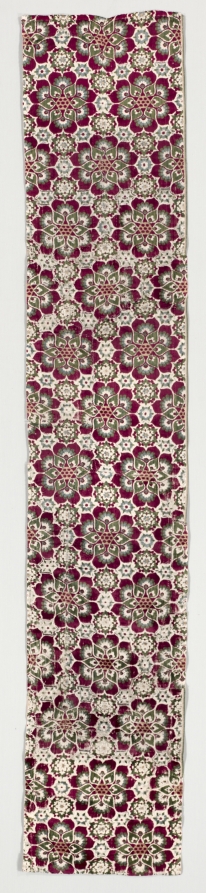
Four-color Velvet with Medici Armorial in Rosettes (1450–1500) is in the Cleveland Museum of Art collection.
The work and its context
The museum's open-access catalogue describes the work:
This polychrome velvet displays the heraldic design of the Medici family of Florence, where it was probably made. The device of crimson balls on a yellow ground appears in the centers of the colorful rosettes. Gilt-metal thread forms the heraldic ground in more lavish examples. The striped selvage helps identify the late 15th-century dating. The rosette pattern created with four colors of pile warp is silhouetted on the ivory satin weave foundation, known as voided velvet. Its color scheme and tile-like design have often been associated with influence from Islamic lands, most likely Turkey.
Object facts
- Title: Four-color Velvet with Medici Armorial in Rosettes
- Date: 1450–1500
- Culture: Italy, Florence
- Type: Velvet
- Technique: silk, velvet: cut pile and voided
- Dimensions: Overall: 211.5 x 40 cm (83 1/4 x 15 3/4 in.); Mounted: 222.3 x 49.5 x 7.6 cm (87 1/2 x 19 1/2 x 3 in.)
- Collection: Textiles
- Department: Textiles
- Accession number: 1943.67
Collection credit
Purchase from the J. H. Wade Fund
Further reading listed by the museum
- Weibel, Adèle Coulin. Two Thousand Years of Textiles; The Figured Textiles of Europe and the Near East. New York: Published for the Detroit Institute of Arts [by] Pantheon Books, 1952.
View the collection record
See the museum's photographs and full catalogue entry. Catalogue text is reproduced from the Cleveland Museum of Art's open-access data, with HTML formatting removed. This object and its supplied image are designated CC0.
Sources
More in Lifestyle
Keep reading