Four Seasons (designed c. 1535, woven mid- to late 1600s): Art, History and Details
Four Seasons at the Cleveland Museum of Art: designed c. 1535, woven mid- to late 1600s, Wool, silk, and gold filé; tapestry weave. Explore the work's context, creator attribution and collection history.
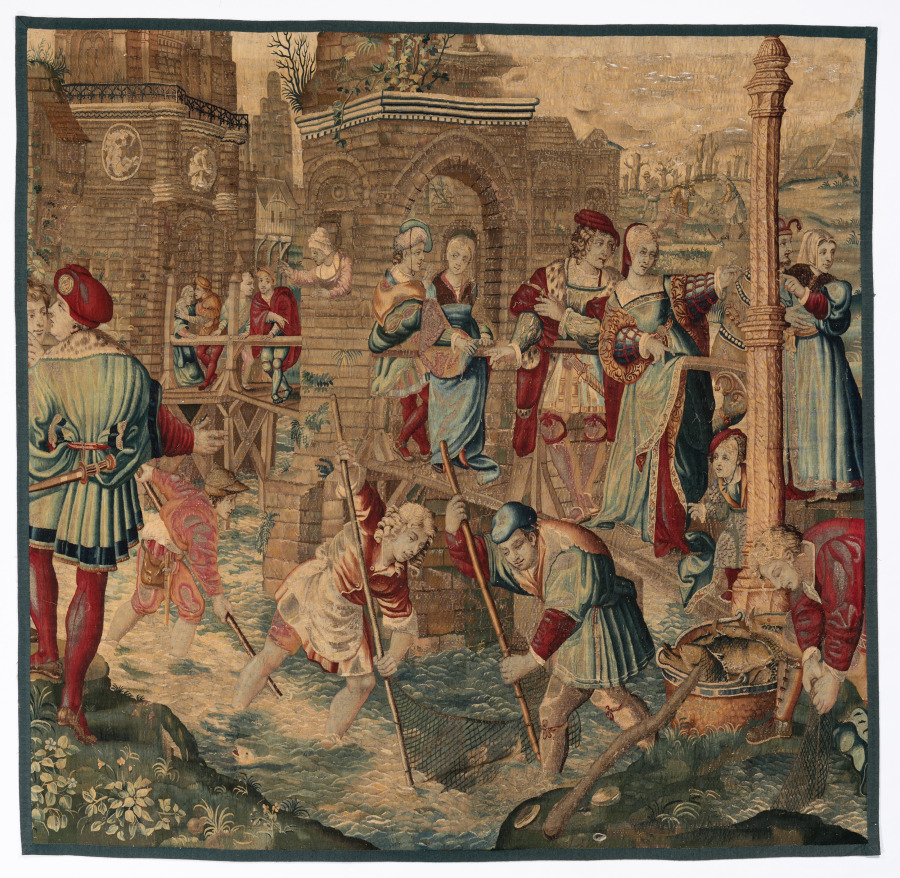
Four Seasons (designed c. 1535, woven mid- to late 1600s) is in the Cleveland Museum of Art collection. The museum's creator attribution is Gobelins Manufactory (France, Paris, est. 1662).
The work and its context
The museum's open-access catalogue describes the work:
Each of these tapestries depict rustic activities appropriate to the season: fishing and gardening for spring, harvesting of grain in summer, wine making for autumn, and ice skating for winter. As tapestries fell out of vogue in the 1700s and 1800s many were burned so their metal threads could be harvested to mint new coins. Before coming to the Cleveland Museum of Art, these tapestries hung in the family home of Frank H. Ginn and Cornelia Root Ginn in Gates Mills, Ohio. Their children donated the tapestries to the museum in 1952.
Object facts
- Title: Four Seasons
- Date: designed c. 1535, woven mid- to late 1600s
- Creator attribution: Gobelins Manufactory (France, Paris, est. 1662)
- Culture: France
- Type: Tapestry
- Technique: Wool, silk, and gold filé; tapestry weave
- Dimensions: Average: 256.5 x 264.2 cm (101 x 104 in.)
- Collection: Textiles
- Department: Textiles
- Accession number: 1952.544
A detail from the museum
At the time of the Four Seasons's production, weavers at the Gobelins Manufactory in Paris were paid on a wage-scale based on the difficulty of the weaving; those who wove heads and flesh tones were paid the most.
Collection credit
Gift of Francis Ginn, Marian Ginn Jones, Barbara Ginn Griesinger, and Alexander Ginn in memory of Frank Hadley Ginn and Cornelia Root Ginn
Further reading listed by the museum
- Warwick House, Ltd, and Lucas. The Balloch Castle Seasons of Lucas; Being Four Gobelin Tapestries Rich with Gold, 8 Feet 2 Inches High, with Combined Width of 41 Feet 7 Inches, from Balloch Castle, Near Glasgow, Where They Hung for Nearly Two Centuries; a Companion Set to the Famous Months of Lucas, and by the Same Designer. Baltimore: N.T.A. Munder & Co., printers, 1918.
- Hunter, George Leland. "The Loan Exhibition of Tapestries." The Bulletin of the Cleveland Museum of Art 5, no. 8/9 (October-November 1918): 63-87
- Hunter, George Leland. Loan Exhibition of Tapestries. Assembled, Arranged and Catalogued by George Leland Hunter. Cleveland Museum of Art. October 5th December 1st 1918.
View the collection record
See the museum's photographs and full catalogue entry. Catalogue text is reproduced from the Cleveland Museum of Art's open-access data, with HTML formatting removed. This object and its supplied image are designated CC0.
Sources
More in Lifestyle
Keep reading