Four seated Masters (c. 1450): Art, History and Details
Four seated Masters at the Cleveland Museum of Art: c. 1450, Gum tempera and gold on cotton. Explore the work's context, creator attribution and collection history.
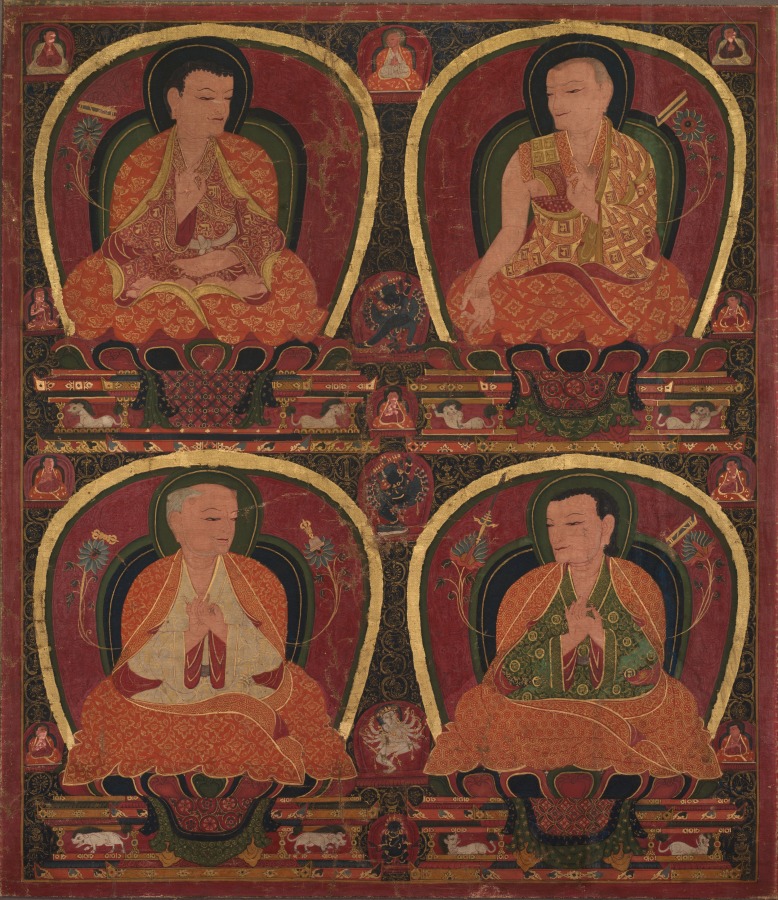
Four seated Masters (c. 1450) is in the Cleveland Museum of Art collection.
The work and its context
The museum's open-access catalogue describes the work:
Founders and prominent masters of the Sakya order of Buddhism in Tibet are featured in this painting as part of the lineage of teachers who transmitted knowledge of their fundamental text, the Hevajra Tantra. It is part of a series of paintings made at one of the main Sakya monastic centers, which had close ties with Nepal. This Tibetan artwork includes Nepalese features, such as the delicate, decorative quality of the painting, its two-dimensionality, the exaggerated curvature of the upper eyelid, and the filling of all spaces with scrollwork.
Object facts
- Title: Four seated Masters
- Date: c. 1450
- Culture: Central Tibet, Ngor monastery
- Type: Painting
- Technique: Gum tempera and gold on cotton
- Dimensions: Overall: 57.7 x 52 cm (22 11/16 x 20 1/2 in.)
- Collection: Tibetan Art
- Department: Indian and Southeast Asian Art
- Accession number: 1960.209
Collection credit
Purchase from the J. H. Wade Fund
Further reading listed by the museum
- The Cleveland Museum of Art. Handbook of the Cleveland Museum of Art/1978. Cleveland, OH: The Cleveland Museum of Art, 1978.
View the collection record
See the museum's photographs and full catalogue entry. Catalogue text is reproduced from the Cleveland Museum of Art's open-access data, with HTML formatting removed. This object and its supplied image are designated CC0.
Sources
More in Lifestyle
Keep reading