Fragment (1200s–1300s): Art, History and Details
Fragment at the Cleveland Museum of Art: 1200s–1300s, Block printing on plain weave cotton ground. Explore the work's context, creator attribution and collection history.
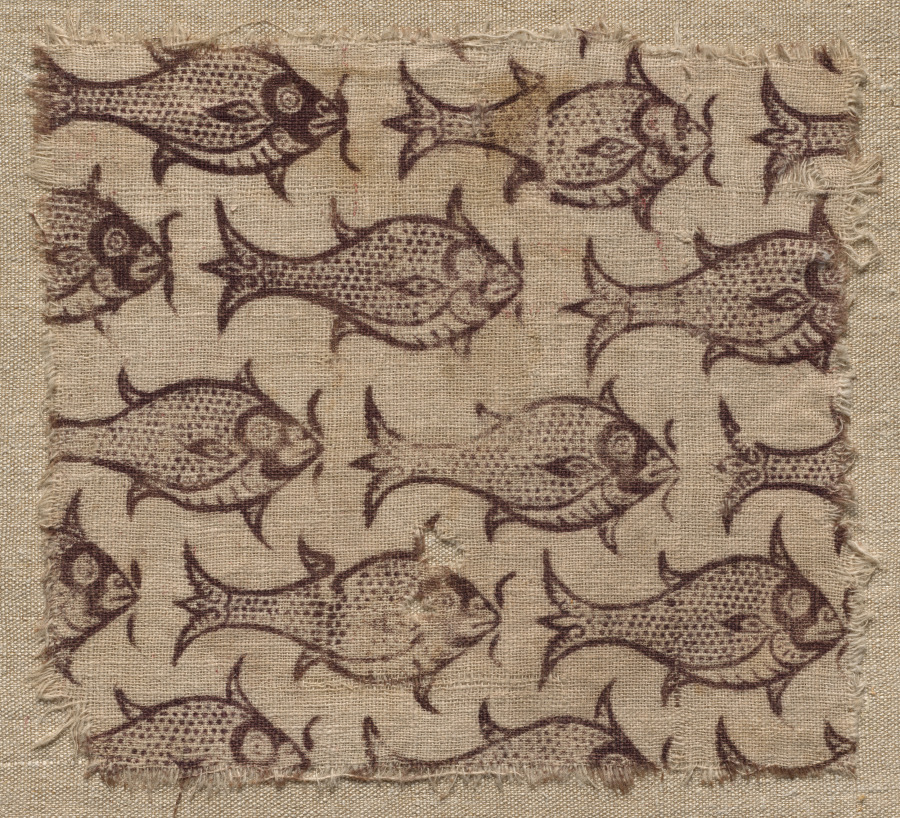
Fragment (1200s–1300s) is in the Cleveland Museum of Art collection.
The work and its context
The museum's open-access catalogue describes the work:
The Indian technique of patterning a textile by printing with carved woodblocks came to the Mamluk world as a result of trade with India. At Fustat, outside of Cairo, numerous fragments of Indian and Mamluk printed textiles have been found. Fish, repeated to form the entire design of this textile, were an indigenous Egyptian motif.
Object facts
- Title: Fragment
- Date: 1200s–1300s
- Culture: Egypt, Mamluk sultanate (1250–1517)
- Type: Textile
- Technique: Block printing on plain weave cotton ground
- Dimensions: Overall: 16.5 x 17.8 cm (6 1/2 x 7 in.)
- Collection: Textiles
- Department: Textiles
- Accession number: 1929.845
A detail from the museum
The break in the bodies of two of the fish reveals that two blocks were used to print each fish.
Collection credit
Purchase from the J. H. Wade Fund
Further reading listed by the museum
- Pfister, R. Les toiles imprimées de Fostat et l'Hindoustan. Paris: Les Éditions d'art et d'histoire, 1938.
- The Cleveland Museum of Art. Handbook of the Cleveland Museum of Art/1978. Cleveland, OH: The Cleveland Museum of Art, 1978.
- The Cleveland Museum of Art. Handbook of the Cleveland Museum of Art. Cleveland, OH: The Cleveland Museum of Art., 1991.
View the collection record
See the museum's photographs and full catalogue entry. Catalogue text is reproduced from the Cleveland Museum of Art's open-access data, with HTML formatting removed. This object and its supplied image are designated CC0.
Sources
More in Lifestyle
Keep reading