Fragment of a Floor Mosaic: Adam and Eve (late 400s–early 500s CE): Art, History and Details
Fragment of a Floor Mosaic: Adam and Eve at the Cleveland Museum of Art: late 400s–early 500s CE, marble and stone tesserae. Explore the work's context, creator attribution and collection history.
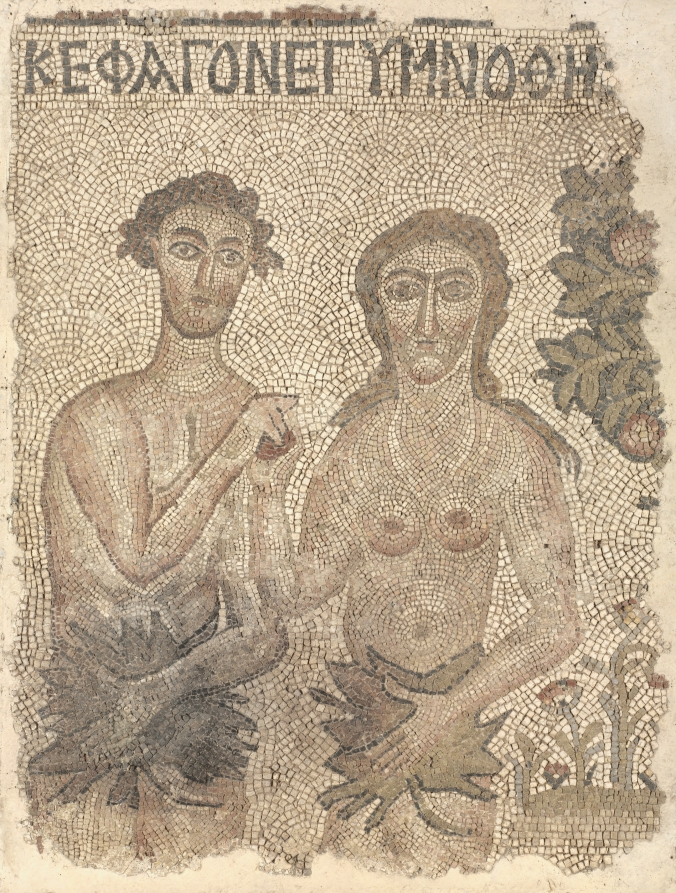
Fragment of a Floor Mosaic: Adam and Eve (late 400s–early 500s CE) is in the Cleveland Museum of Art collection.
The work and its context
The museum's open-access catalogue describes the work:
This mosaic panel representing the Fall of Adam and Eve once formed part of a much larger mosaic decorating the floor of an early Byzantine church in northern Syria. Here, Adam and Eve are portrayed sharing the forbidden fruit while covering themselves with large leaves. At the top of the panel, a Greek inscription reads, "And they ate and they were made naked," recalling the biblical text (Gen. 3:7) and highlighting the two moments in the biblical narrative of the Fall that are depicted here.
Object facts
- Title: Fragment of a Floor Mosaic: Adam and Eve
- Date: late 400s–early 500s CE
- Culture: early Byzantium, Northern Syria, Byzantine period, late 5th-early 6th century
- Type: Mosaic
- Technique: marble and stone tesserae
- Dimensions: Overall: 142.9 x 107.3 x 5.7 cm (56 1/4 x 42 1/4 x 2 1/4 in.); Mounted: 142.9 x 107.3 x 7 cm (56 1/4 x 42 1/4 x 2 3/4 in.)
- Collection: MED - Byzantine
- Department: Medieval Art
- Accession number: 1969.115
A detail from the museum
In the Syrian village where this mosaic was created, few people could read and even fewer had access to books. The images within the church educated the community, leading 5th-century Pope Gregory the Great to describe religious images as "books for the illiterate."
Collection credit
John L. Severance Fund
Further reading listed by the museum
- "The Year in Review for 1969." The Bulletin of the Cleveland Museum of Art 57, no. 1 (January 1970): 2-50
- Donceel-Voûte, Pauline. Les Pavements des Eglises Byzantines de Syrie et du Liban: Décor, Archéologie et Liturgie. Louvain-la-Neuve: Département d'Archéologie et d'Histoire de l'Art, 1988.
- Cleveland Museum of Art, and Holger A. Klein. Sacred Gifts and Worldly Treasures: Medieval Masterworks from the Cleveland Museum of Art. Cleveland, Ohio: Cleveland Museum of Art, 2007.
View the collection record
See the museum's photographs and full catalogue entry. Catalogue text is reproduced from the Cleveland Museum of Art's open-access data, with HTML formatting removed. This object and its supplied image are designated CC0.
Sources
More in Lifestyle
Keep reading