Fragment of a Goat's Head (c. 500–475 BCE): Art, History and Details
Fragment of a Goat's Head at the Cleveland Museum of Art: c. 500–475 BCE, limestone. Explore the work's context, creator attribution and collection history.
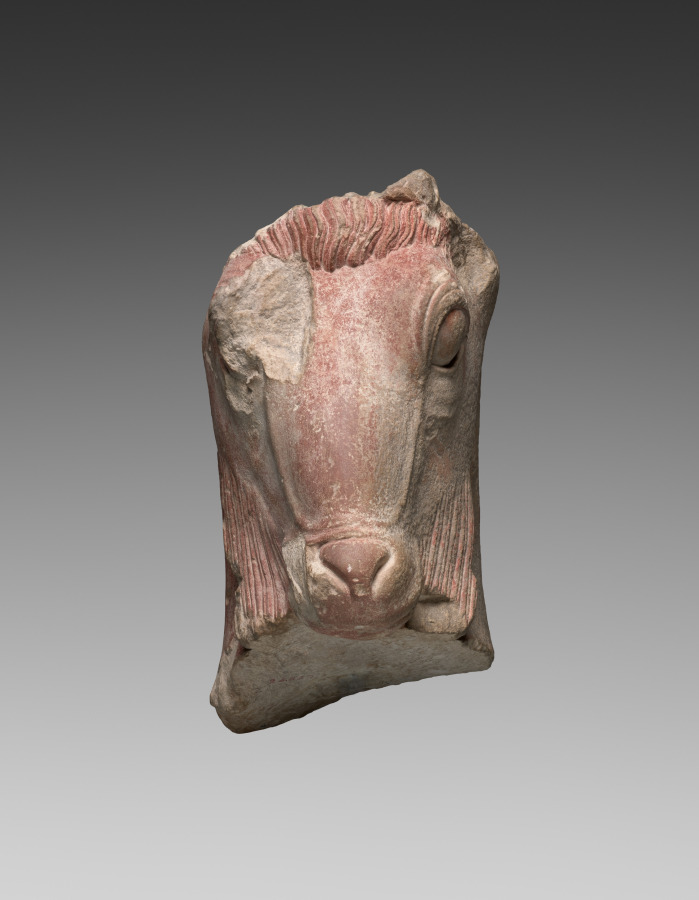
Fragment of a Goat's Head (c. 500–475 BCE) is in the Cleveland Museum of Art collection.
The work and its context
The museum's open-access catalogue describes the work:
Initially identified as a horse head, this fragmentary sculpture, once painted reddish-brown, has a beard, indicating that it depicts a goat. Its large size, however, together with its neck position and unusual round eye, have all prompted questions. Was the head broken from a rearing goat? Or did it represent Pan, the rustic shepherd god often depicted as half-man, half-goat? If Pan, some scholars have connected it with a fifth-century BC Athenian sanctuary erected to thank the god for aid in battle. An alleged provenance near the Athenian Acropolis supported this idea, but scientific tests suggest otherwise.
Object facts
- Title: Fragment of a Goat's Head
- Date: c. 500–475 BCE
- Culture: Greece
- Type: Sculpture
- Technique: limestone
- Dimensions: Overall: 35 cm (13 3/4 in.)
- Collection: GR - Greek
- Department: Greek and Roman Art
- Accession number: 1926.538
A detail from the museum
Pan, the goat-headed god, is often called a son of Hermes, but sources disagree.
Collection credit
Gift of Leonard C. Hanna Jr.
Further reading listed by the museum
- The Brummer Gallery Records. Cloisters (Museum), n.d.
- Howard, Rossiter. "The Head of an Archaic Goat." The Bulletin of the Cleveland Museum of Art 14, no. 3 (1927).
- International Studio (June 1927).
View the collection record
See the museum's photographs and full catalogue entry. Catalogue text is reproduced from the Cleveland Museum of Art's open-access data, with HTML formatting removed. This object and its supplied image are designated CC0.
Sources
More in Lifestyle
Keep reading