Fragment of a Necklace (1540–1296 BCE): Art, History and Details
Fragment of a Necklace at the Cleveland Museum of Art: 1540–1296 BCE, steatite, glass, carnelian, and faience. Explore the work's context, creator attribution and collection history.
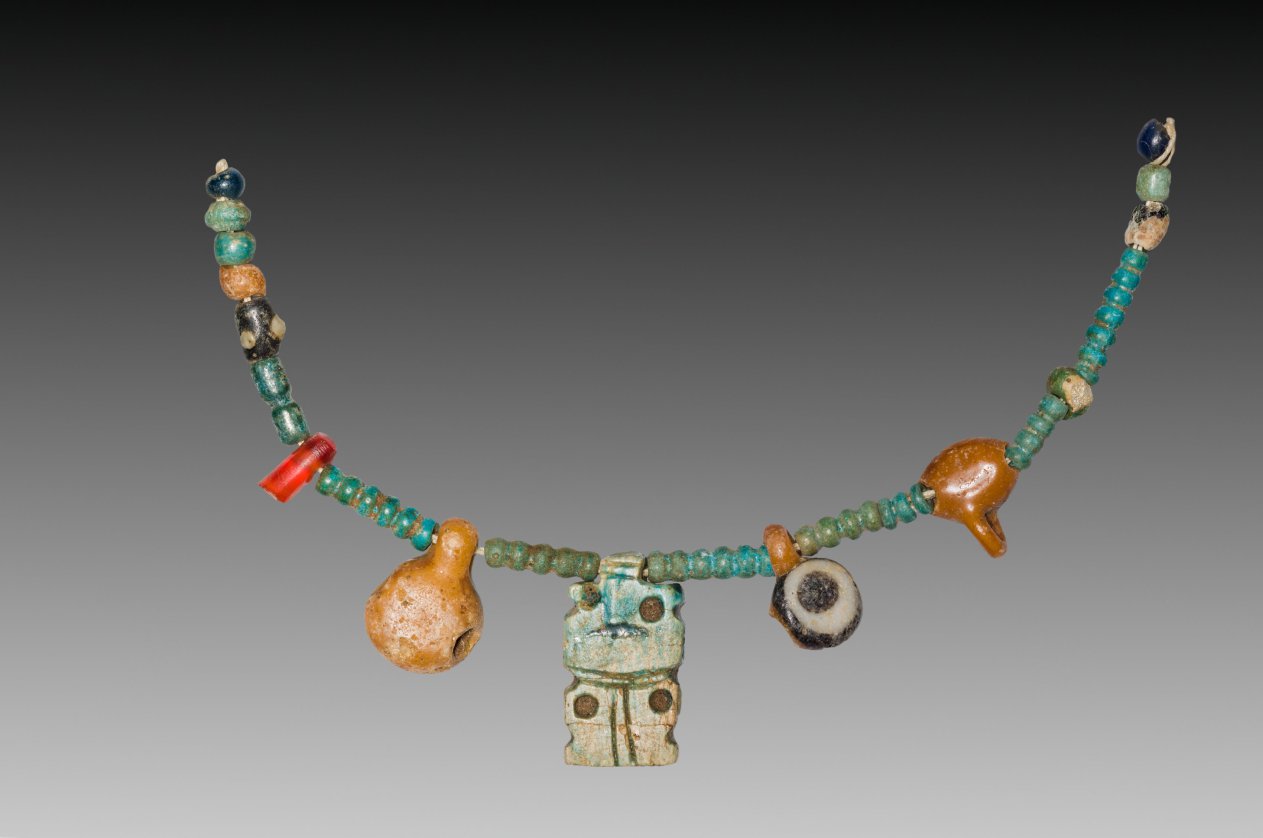
Fragment of a Necklace (1540–1296 BCE) is in the Cleveland Museum of Art collection.
The work and its context
The museum's open-access catalogue describes the work:
This necklace is a modern stringing from an assortment of beads made from glass, faience, glazed steatite (one amulet), and carnelian (one fragment). The glass beads include three eye beads, two barrel beads in opaque blue glass with white crumb decoration, one barrel bead in opaque blue glass, one turquoise barrel bead, one amber cylinder bead, and one blue cylinder bead. The eye beads were made with an opaque amber glass and decorated on the front with an eye in blue and white opaque glass. They are pierced through their sides and have a suspension loop at the top.
Object facts
- Title: Fragment of a Necklace
- Date: 1540–1296 BCE
- Culture: Egypt, New Kingdom (1540–1069 BCE), Dynasty 18
- Type: Jewelry
- Technique: steatite, glass, carnelian, and faience
- Dimensions: Overall: 12 cm (4 3/4 in.)
- Collection: Egypt - New Kingdom
- Department: Egyptian and Ancient Near Eastern Art
- Accession number: 1915.15
A detail from the museum
The carnelian bead, known by its fiery color, is broken and consists of little more than its suspension hole.
Collection credit
Gift of the British School of Archaeology in Egypt
Further reading listed by the museum
- Berman, Lawrence M., and Kenneth J. Bohač. Catalogue of Egyptian Art: The Cleveland Museum of Art. Cleveland, OH: Cleveland Museum of Art, 1999
View the collection record
See the museum's photographs and full catalogue entry. Catalogue text is reproduced from the Cleveland Museum of Art's open-access data, with HTML formatting removed. This object and its supplied image are designated CC0.
Sources
More in Lifestyle
Keep reading
Related stories


